Human Rights Commission Looks Ahead to the New Year
Written By Patrick DeVivo
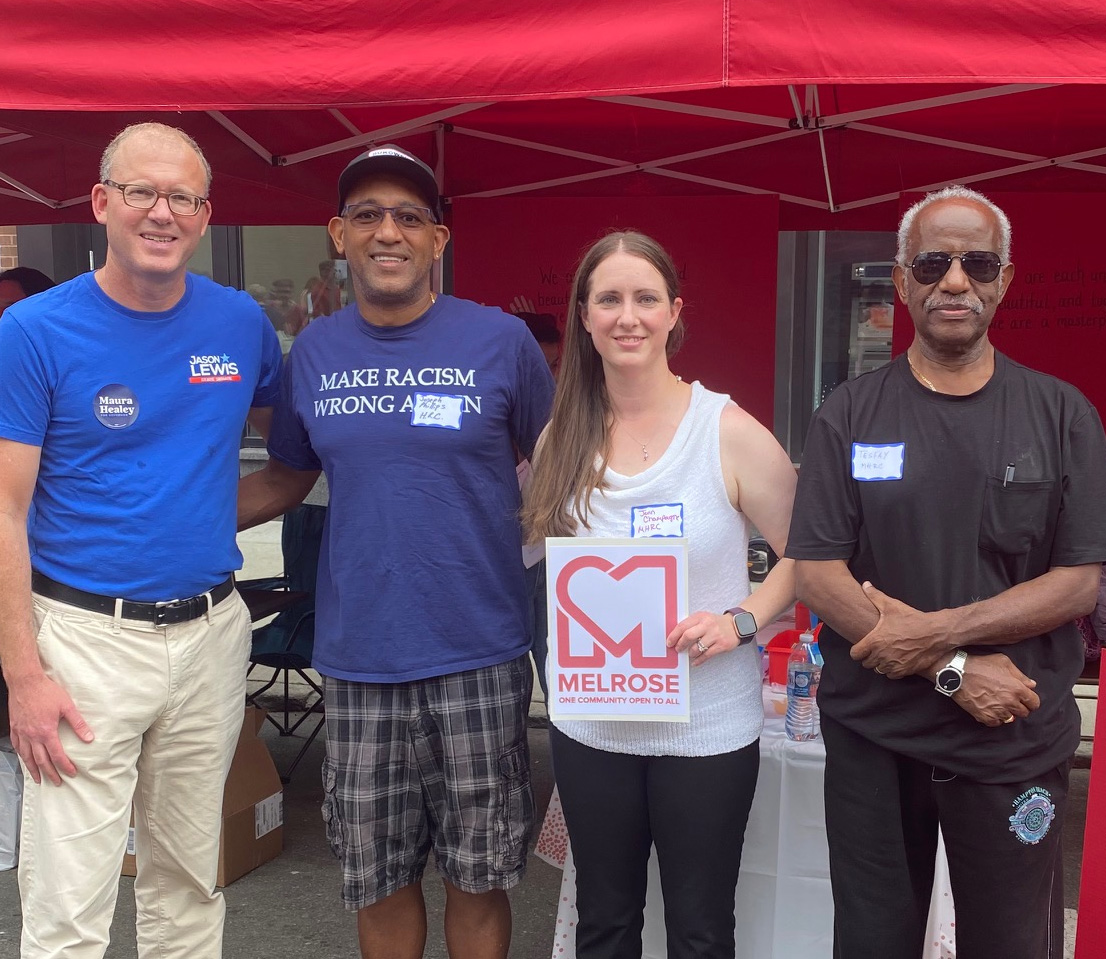
Members of the Human Rights Commission with State Senator Jason Lewis (left) at the Victorian Fair in 2022
From the Melrose Human Rights Commission
As the new year approaches, the Melrose Human Rights Commission (MHRC) is planning an active 2026 with new members and a shift of focus.
The goal of the MHRC is “to work closely with city leadership and partners to address issues of civil and human rights, reinforce a positive atmosphere in the community, and amplify and promote organizations and people working to make Melrose one community open to all.”
Lizzy Barr, the Chair of the MHRC, recently reflected on the commission’s accomplishments over the past year and its priorities for the future.
The past year brought several personnel changes for the MHRC, including Barr stepping into the role of Commission Chair last March. She moved to Melrose in 2021 and joined the MHRC in 2024. The MHRC also welcomed four new Commissioners: Brian Kochenowski, Elizabeth Kowal (who was recently elected to the City Council), Laura Bergsten, and Linda Thompson. This group joins three existing members: Kelsey Lima (Vice Chair), Jay Strapp (Treasurer), and Randall Carter (Clerk). Currently, there are three open positions on the MHRC. All Commissioners must be Melrose residents, and they are all volunteers.
Despite the turnover, Barr feels the MHRC had a productive year in 2025. It finalized and made available for distribution three Resource Guides, one each for Immigration and Refugee matters, Legal and Civil Rights concerns, and LGBTQ+ issues. These guides provide up-to-date contact information for governmental agencies and non-governmental organizations that exist to assist individuals with questions or concerns in any of the three areas. This includes steps to follow if an individual wishes to report a civil or human rights violation. The guides are available on the MHRC’s home page on the city website, and hard copies are available at City Hall.
The MHRC also began distributing Red Cards, which are small, printed cards that inform individuals, especially immigrants, of their constitutional rights. The cards are available in a wide range of languages, and they are also available at City Hall.
In addition to providing these resources, the MHRC is in the final stages of creating an intake form and process to use when civil or human rights concerns are reported directly to the Commission. Use of the intake form and process will help ensure that these reports are triaged appropriately by the Commissioners so those who file complaints are promptly referred to relevant state and federal agencies or to community organizations for support.
Barr stressed that the form and process will also allow Commissioners to more easily follow up with the reporting person to ensure they are connected with the proper resources. They also supply documentation that helps the Commission spot trends in reports, which can indicate broader systemic issues.
From the Melrose Human Rights Commission
The origins of the Melrose Human Rights Commission go back to the early 1990s, when a Melrose family’s home was defaced with racial slurs. The shock and outrage caused by this act, and the concern that city leaders might be out of touch with the community, prompted a broad array of city leaders, religious, educational, and social organizations, and residents to come together and form a non-governmental committee called the Melrose Human Rights Coalition.
The Coalition studied the responses of surrounding communities to civil rights issues and recommended steps to ensure that any report of a civil rights violation in Melrose would be handled immediately and effectively. It also supported efforts to publicize the city’s commitment to supporting the civil and human rights of all.
After two years of work, the Coalition recommended the creation of a Human Rights Commission that would build upon the work of the Coalition and be a formal part of city government. This would signal to the public the high priority that the city places on civil and human rights and help ensure long-term recognition and resources to address these issues in the city. In September 1991, the City Council and then mayor James Milano approved the creation of the Melrose Human Rights Commission under Chapter 2, Article XIX of the city’s ordinances.
Over the years, the MHRC has led numerous efforts to raise awareness of the city’s support for civil and human rights. These efforts include: establishing the tag line, “Melrose: One Community, Open To All,” rolling out a “Free Our Minds” campaign, organizing a “Culture Walk” at Melrose High School, placing public service messages broadcast on MMTV, drafting a human rights declaration signed by over 1000 residents, and organizing focus groups, community workshops, and a candlelight walk.
According to Barr, the current commission’s priorities are shifting somewhat. “There is a need to move away from purely event-based work to what I call service-based, or tangible, action-based work,” says Barr.
She adds that supporting city events that recognize and celebrate civil and human rights throughout the year will still be important to the MHRC. However, the priority will be to focus on establishing an effective, credible, and timely investigative and response process that enforces these rights by addressing actual situations. Barr states that this will involve partnering with city departments like the police and the housing authority and with other city organizations that deal with civil rights issues, such as the Commission on Disability, the Commission on Women, the Council on Aging, the Veterans Services Advisory Board, and the Melrose Alliance Against Violence.
Barr clearly brings passion to her still-new role. “I joined the MHRC in 2024 because there was so much going on in the world, so much chaos, and I wanted to take a stand, but for me, it needed to be on a local level.” She adds, “I think this is a time when people feel motivated by what they might see around them - instead of feeling powerless and sad by what’s in the news, they see it as an opportunity to get involved.”
More information about the Melrose Human Rights Commission can be found on their website or at 781-979-4140. The commission meets remotely on the second Monday of each month (except for July and August) at 6pm. Meetings are open to the public.