Board of Appeals Continues Discussion of Proposed Summit Ave Development
By Ellen Putnam
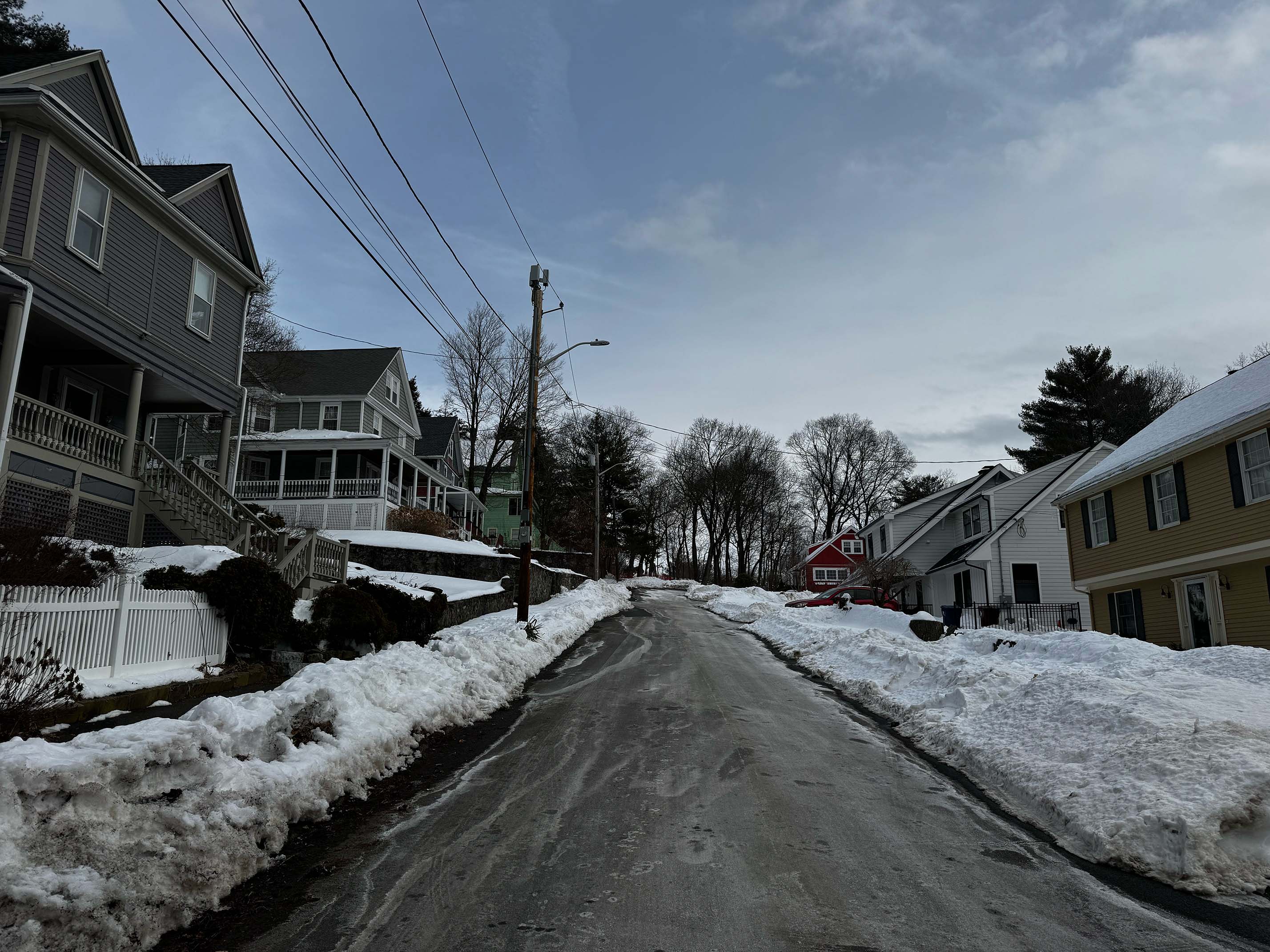
Summit Ave
(34 & 55 Summit Ave is the wooded area at the top of the street)
This week, the city’s Zoning Board of Appeals (ZBA) continued their discussion of the proposed development at 34 & 55 Summit Ave in the Melrose Highlands. The current plans for this property were filed under state housing law Chapter 40B and have been under review at the ZBA since last summer.
Developers who agree to include 20% or 25% affordable units in their project can file their proposal under Chapter 40B, which allows them to bypass much of the local permitting process, and have their project reviewed as a comprehensive permit application. If less than 10% of the total housing units in a city or town are affordable (as defined by state law) and the local zoning board denies a comprehensive permit for a 40B project, then the developers can appeal that decision to the state’s Housing Appeals Committee.
Litigating the denial of a comprehensive permit before the Housing Appeals Committee can take years and a significant expenditure of legal resources. The Housing Appeals Committee requires a local zoning board to demonstrate “valid local concerns that outweigh the regional need for affordable housing” - a standard that is notoriously difficult to meet.
It’s worth noting that, out of 20 decisions on permit denials over the last 15 years, the Housing Appeals Committee has only once sided with the local zoning board - a case in Newton in 2015, where a deed restriction predated the passage of Chapter 40B in 1969. In all other cases - which included concerns about environmental impacts, stormwater management, emergency access, increased traffic, density out of character with the neighborhood, and losing open space - the Housing Appeals Committee ruled in favor of the developers.
Melrose is approaching the 10% affordable housing “safe harbor” number, and two projects that are currently in the pipeline but have not yet been officially filed - a residential development on the site of the historic Benjamin Lynde House on Main Street and affordable housing for seniors on the site of the Green Street Baptist Church - could put Melrose over the 10% line. (And given that Melrose currently requires all new residential developments of five or more units to designate at least 15% of units as affordable, each new development that is built does add to the affordable housing total.) However, the Summit Ave project was filed last year, so achieving “safe harbor” status would not prevent the Summit Ave project from going through.
The 34 & 55 Summit Ave proposal is for a 28-unit for-sale townhome development with 56 parking spaces and 11 visitor spaces at the top of a very steep, narrow road in the hills above Franklin Street. Currently, the site is mostly undeveloped land with two single-family houses on it. While the site is not far from the Melrose Highlands train station, steep hills do not make the site very pedestrian-friendly.
The Summit Ave developers had originally planned to build four two-family buildings on the site, and later amended the plans to six single-family homes. After the Planning Board raised concerns about stormwater management, the developer refiled the application as a larger-scale, 40B project.
The City wrote a letter in opposition to the project, citing issues with blasting and drilling; stormwater management and drainage; the project’s density and its impact on the surrounding environment; increased traffic on Summit Ave; and access to the site for emergency and delivery vehicles. Despite these concerns, the Massachusetts Housing Finance Agency determined that the project was eligible for funding and could move ahead to review by the ZBA.
The ZBA, at the conclusion of its review process (which will likely be sometime this spring), can vote to either approve the comprehensive permit application - most likely with conditions - or deny it. If they deny the permit application, then the developer can appeal to the state’s Housing Appeals Committee. (The developer can also appeal any conditions the ZBA imposes that they feel are too onerous.)
In order to construct the nine buildings that are planned, extensive blasting of the site will be required, creating some significant differences in elevation throughout the site, as well as some high retaining walls. The stormwater management system will need to capture water that could otherwise rush down Summit Ave and into neighbors’ backyards and basements. And the loop road that will be constructed to service the development will be relatively steep and narrow.
Throughout the review process so far, neighbors whose homes are downhill from the planned development have expressed significant concerns about the project, including potential damage from blasting, which some neighbors fear could destabilize large boulders that sit above their homes; stormwater runoff from the development flooding their property; the impact of adding much more traffic - construction vehicles, and then residents’ vehicles - to the steep and narrow Summit Ave; and noise and privacy concerns.
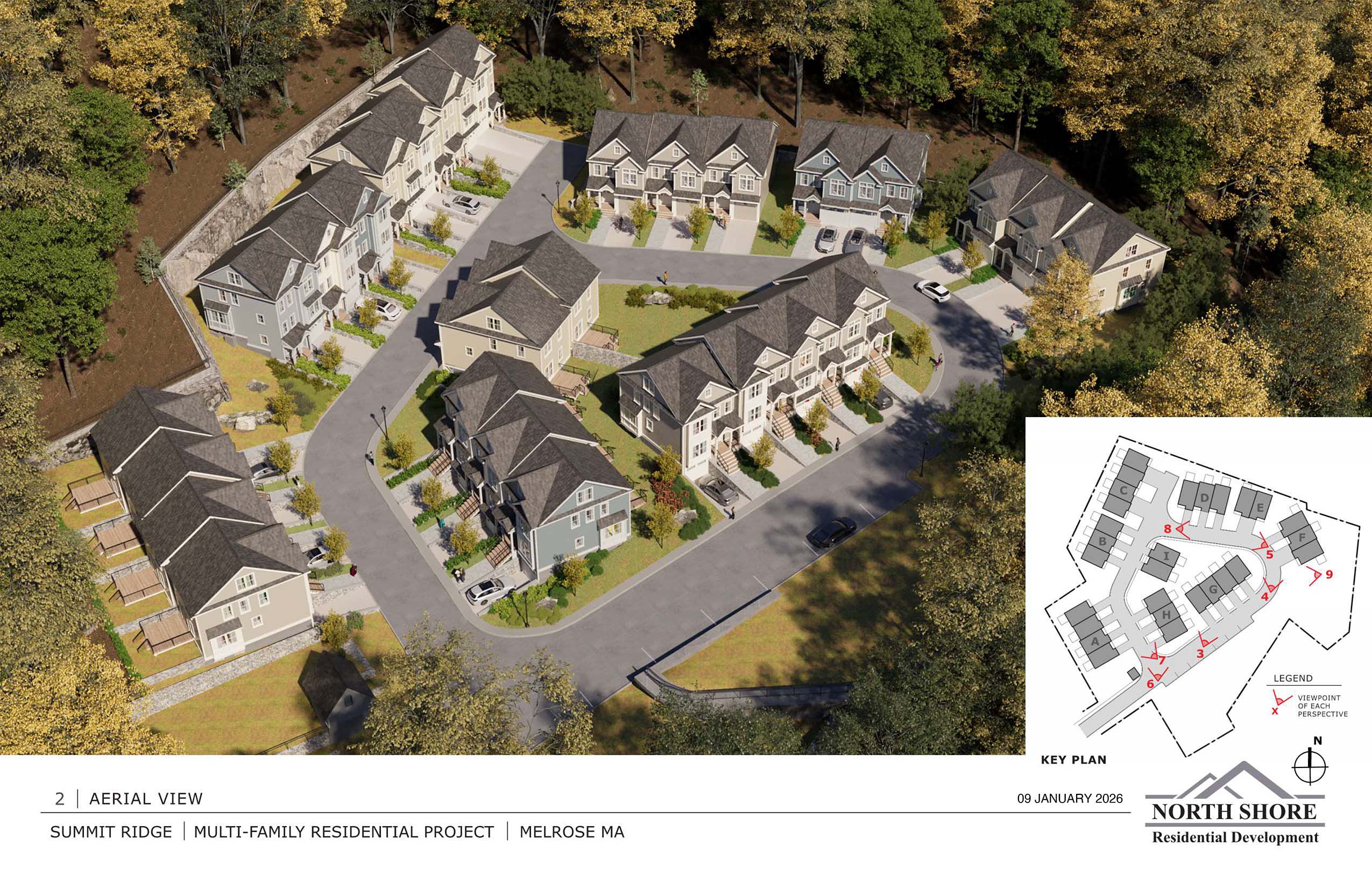
Architectural rendering of the proposed development at 34 & 55 Summit Ave
Even members of the project team admitted that the site is less than ideal for the planned development. “The more I get into this work,” reflected project engineer Michael Malynowski, “the worse the sites get, because all of the good sites are taken. So we are getting very creative with how we’re doing this.”
David Roache, the ZBA member who has raised the most concerns throughout the process so far, had a less optimistic take: “This is the most aggressive proposal you could put on this site,” he said. “The reality is, you’re trying to get too much on there, for what the site can support in 3D. If the site were flat and you wanted to put in 28 townhouses there, then sure, but it’s not flat. There’s a reason this property is undeveloped, and that’s because it’s a challenging site. I agree, the good sites are gone. But the reality is, you can’t get the same amount of yield on a bad site as a good site without doing some really crazy things - like what’s being done here.”
“This road is way too steep with way too many houses,” Roache added. “It’s going to be jammed up with cars, and it’s going to be an issue for fire trucks, the way it is designed right now.”
Roache also questioned oversight of the development’s systems, in particular its stormwater management system, once construction is complete and the responsibility for maintenance would shift to a condominium association. “Let’s be honest,” he said, “those are never going to be maintained.”
The project’s attorney, Christopher Agostino, pointed out that the ZBA could ensure that the condominium association’s documents and budget provide for continued maintenance of the system, although that would still require someone to plan for ongoing maintenance, or for city officials to require the system to be inspected regularly.
With only a few months left in the ZBA’s deliberation process, this week’s meeting indicated some tension between the applicant and the Board.
Agostino suggested that the Board and the developer could resolve some of the issues under discussion during a work session - a suggestion that City Planner Lori Massa rejected, stating that the Board did not feel comfortable holding a work session outside of a public hearing.
Agostino then said, “If the Board’s position is that they’re uncomfortable with the design as a whole, then it doesn’t make sense to discuss this level of detail.”
“We’re trying to look at this project as it’s been presented to us,” responded ZBA Chair Bryan Thorp. “This is a complicated project, and you cannot divorce it from the technical aspects. I’m not overjoyed with this, but my responsibility is to look out for the city and residents’ interests and look at this project, regardless of my personal opinion.”