A Snowy Winter for the Melrose Department of Public Works
By Ellen Putnam
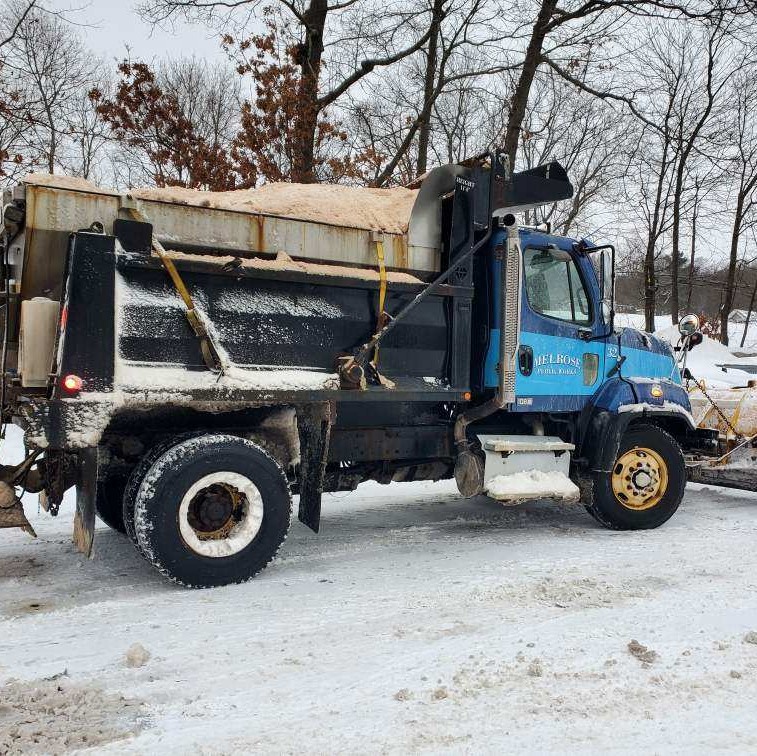
Photo From City of Melrose
As Melrose deals with one of the snowiest winters we’ve had in years, the city’s Department of Public Works (DPW) has been focused on keeping roadways and sidewalks clear, despite challenging conditions.
Although our city is only four-and-a-half square miles, the DPW is responsible for clearing over 90 miles of roadways, in addition to the city’s parking lots and some sidewalks.
And contrary to what residents might expect, snow clearing is one part of the city’s budget where there is little flexibility to take into account the city’s larger financial considerations.
“We need to think about safety first in regard to snow clearing,” said DPW Director Elena Proakis Ellis. “During a storm, we do what we have to do for safety, and we can’t sacrifice safety for budget.”
The DPW sends equipment out to salt and clear roadways whenever there is winter precipitation that could make the roads unsafe. But major storms like the two we saw earlier this month - each of which dropped more than a foot of snow on the city - require more extensive planning.
“It’s a complex process,” said Deputy Director Jim Troup. “Forecasters are less willing to give snow totals, and they have all these different models. And we’re in a tough situation here, near the 128 belt - it’s a big elevation change, so we might be in the jackpot, or a storm might miss us completely.”
When a large storm is in the forecast, DPW staff work with the Melrose Public Schools, the Police and Fire Departments, and the mayor’s office to make decisions about school closure and parking bans and line up contractors for snow removal if needed. “It’s a very fluid process,” said Troup, “and our plan might change if the storm oscillates. We have to wait, stay patient, and use whatever information is out there to be able to plan and pivot.”
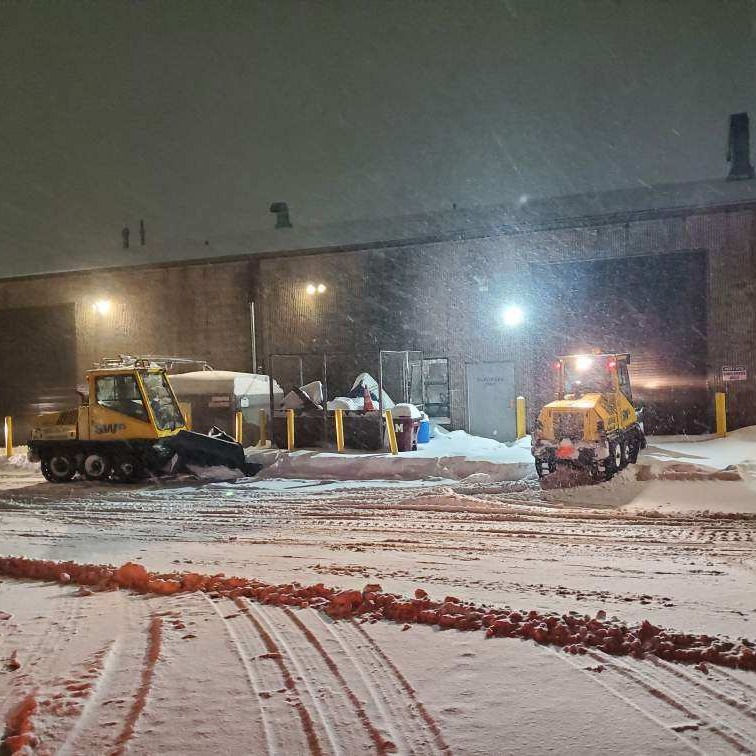
Photo From City of Melrose
For what DPW staff call an “all-in” snow event like the two storms we saw earlier this month, that plan can be very complex.
In addition to the roughly 25 pieces of snow removal equipment the DPW owns and operates, contractors might bring in as many as 30 or 40 additional plows. “We have 25 plow routes, and within each route, when we’re able to, we put two people on the route,” said Ellis, “and then there are parking lots and dead ends. Depending on how many people and equipment we have for a given storm, we could be looking at more than 50 moving parts.”
For a large snow event, over 50 DPW employees who work in a variety of roles - including road work, sanitation, parks, or facilities maintenance - are brought in to work on snow clearing. Employees come in before the snow starts falling to prepare their equipment, and they stay throughout the storm, taking naps in chairs or in their trucks when they need a break. (“We do encourage our staff to take breaks,” said Ellis. “Nobody is driving straight through the night.”)
During the storm itself, Ellis explained, “our absolute first priority is making sure the roads are passable. That emergency vehicles can get through, and people aren’t going to get stuck. Hills and the main drags are a lot of our focus, because those have the greatest potential for having an issue. The main drags are where people are more likely to be driving during the storm, and hills are where people are more likely to get stuck or slide down into another street.”
“Driving safety is our first priority during the storm,” she went on, “and then, at the end of the storm, sidewalks become our priority.” The DPW uses sidewalk plows to clear specific sidewalk routes, although sidewalk clearing is generally the responsibility of abutting property owners.
After major snowstorms, the DPW often removes piles of snow from the downtown area, parking lots, and around curb ramps. Snow removal is generally done at night, with the help of contractors who bring in dump trucks to haul the snow up to the DPW’s facility on Route 99.
While all cities and towns in the region are responsible for removing snow from roadways, not all of them clear sidewalk routes or put effort into removing or reducing large snowbanks.
“I’d like to think that our snow removal is on par with the communities that are doing the best job,” reflected Ellis. “It’s always a balancing act with cost - you don’t want to go overboard and not be cost-effective. But I’d like to think that, when people are driving from town to town, Melrose is among the better communities.”
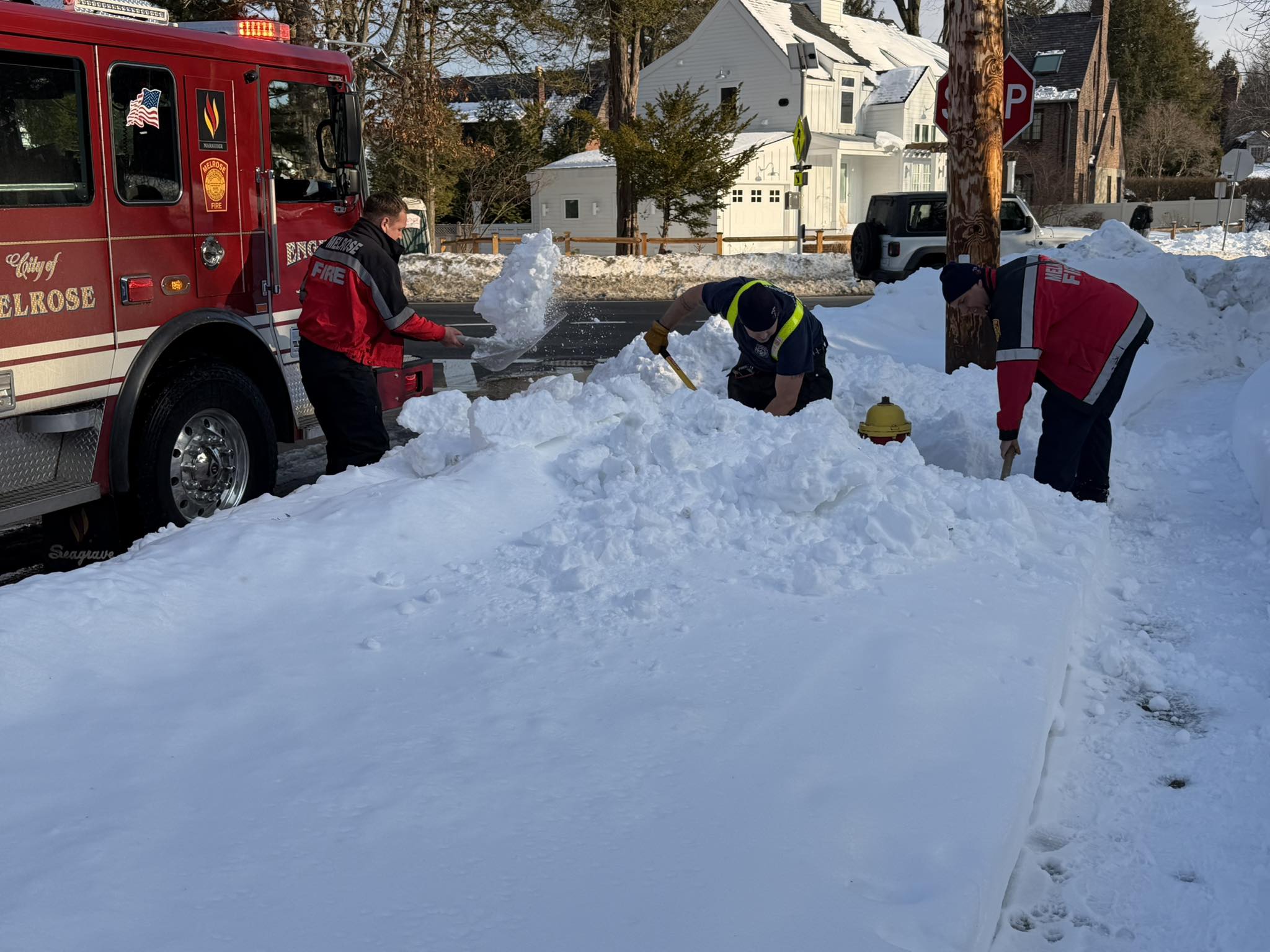
Photo Credit: Nancy Clover
The city’s budget category for snow removal works differently from other budget categories. By state law, the snow removal budget category is the only one that municipalities can spend in deficit, and cities can choose to finance overages in the snow removal category over three years.
“In 2015, pretty much every city had to finance the deficit spending that took place to cover the storms we had that year,” Troup recalled. “We’ve been pretty fortunate in Melrose to have a great financial team that has identified resources so we don’t have to finance our deficit.”
Last year, the DPW spent almost $250,000 above the $725,000 that was budgeted for snow removal - a deficit that the City Council voted to cover using the city’s free cash funds. This year’s total may still grow, but last week’s storm alone cost over $200,00, including salt, fuel, overtime for DPW workers, and contractors. Governor Maura Healey declared a state of emergency following this storm, which may open up some state funds to cover those costs.
While the DPW is responsible for keeping roadways and some sidewalks clear, Troup emphasized, “Snow removal is a community effort. No one entity is responsible for everything. We have to all do our part to be good neighbors and good community partners.”
Some nearby municipalities require all property owners - commercial and residential - to clear the sidewalks that adjoin their property. (John Kerry was once famously fined $50 for failing to clear the sidewalk in front of his Beacon Hill residence while he was out of the country in his role as Secretary of State.)
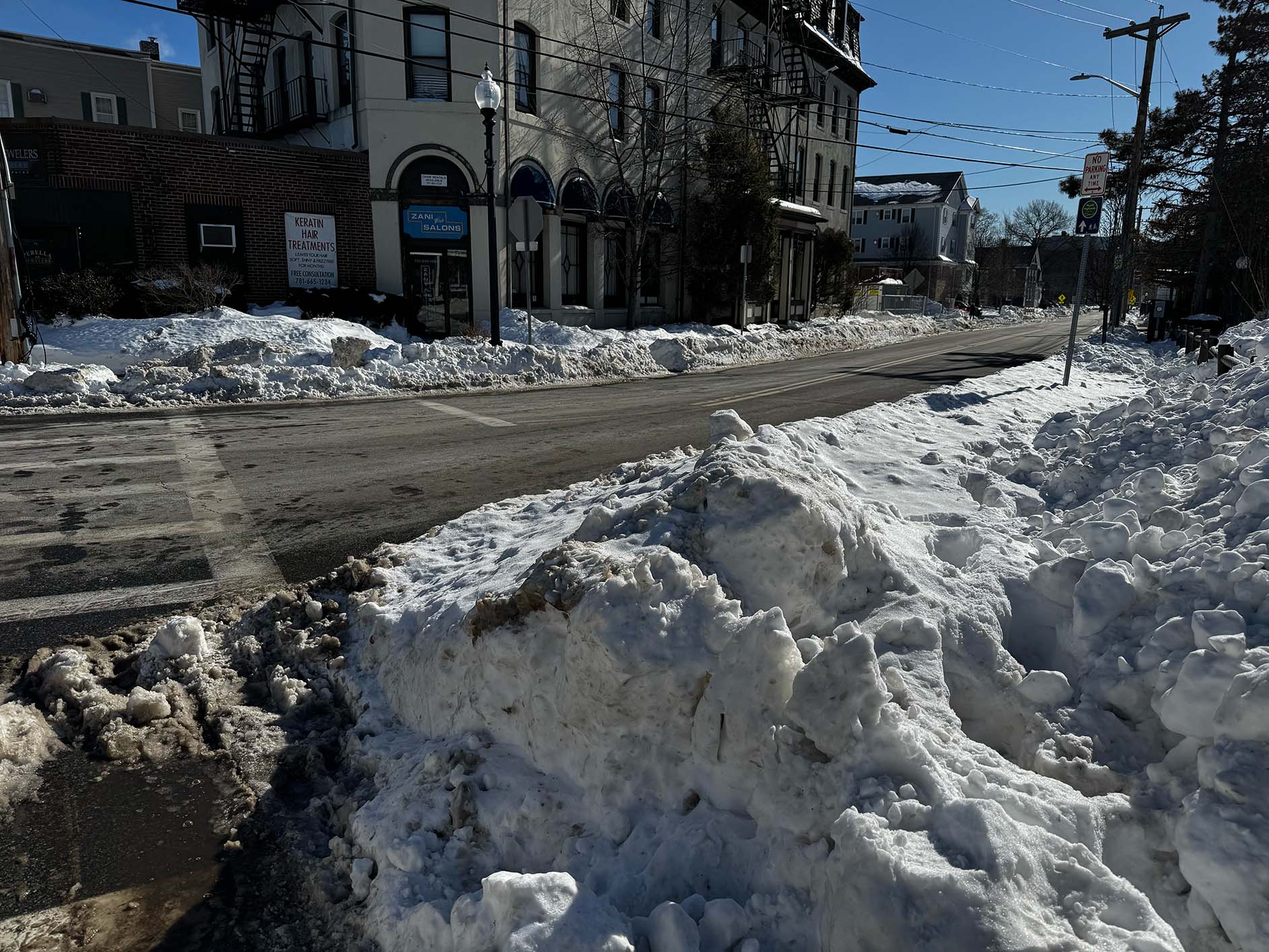
Last year, the Melrose City Council debated adding such a provision to Melrose’s city ordinance, but the Council’s Legal and Legislative Committee could not come to a solution that members felt was equitable for property owners who might struggle to clear snow on their own. As it stands, only property owners “in those sections of the City containing commercial, office and manufacturing facilities” can be fined $50 for failing to clear their sidewalks. According to the ordinance, other property owners “shall cause all snow and ice to be removed from the sidewalks adjoining such estate,” but there is no enforcement mechanism in place for that provision.
Not all property owners clear adjacent sidewalks
Photo Credit: Ellen Putnam
This means that, aside from the sidewalks that the DPW clears, sidewalks in the rest of the city can be a patchwork of well-cleared, wide sidewalk paths that individuals in wheelchairs or pushing strollers can easily navigate, and paths that have not been cleared at all.
Shoveling out fire hydrants is another task that the city asks for community assistance on. While the Fire Department does send crews to shovel out fire hydrants, getting to all of the city’s hydrants can be a challenge, so residents are encouraged to shovel out hydrants in their neighborhoods.
This year, Chief John White and Secondary Principal Jason Merrill determined that high school students could earn community service hours for shoveling out fire hydrants. “Some high school students have gotten some serious community service hours digging out fire hydrants,” noted Communications Manager Tom Dalton.
The DPW also asks residents to do their best to shovel out curb ramps in their neighborhoods, making the sidewalks accessible to everyone. With the size of the snow banks last week’s storm created - on top of snow banks from earlier this month - some residents reported that shoveling out their curb ramps became difficult in some parts of the city.
“Ideally, if people are able to shovel out the curb ramps in their neighborhood,” said Ellis, “that’s the best case. There are hundreds around the city, and there is no way that we can get out and do removal for all of them. If there is a specific issue that someone can’t handle and they call us, we do try to help, but we ask people to try to take care of things themselves.”
“The bulk of the work falls on the DPW,” Troup added, “so sometimes we lose sight of certain responsibilities that everybody has during storms. We’re more than appreciative when people help out. The more people help out and do their part, the stronger our city will be.”