A Conversation with Jay Higgins, Candidate for State Representative
By Ellen Putnam

Photo From Jay Higgins
While Jay Higgins’ name may be new to many Melrose residents, you may have already interacted with him without knowing it - he has worked for the last decade as a senior caseworker for our congresswoman, Katherine Clark.
“I’ve been in public service since I joined the Air Force at age 19,” Higgins said. “I have always had a desire to help people, and I get immense joy out of helping someone make a situation better. I’ve helped constituents get their Social Security turned on after 12 months of fighting the Social Security Administration and having no income. I’ve helped small businesses get access to emergency financial relief so they could stay open during COVID. That’s what keeps me going.”
In addition to his time in the Air Force and working for Clark, Higgins has degrees in political science, including a Master of Liberal Arts in Government from the Harvard Extension School.
“I’m running for state representative,” he said, “because I want to keep doing the work of helping people improve their lives, and start having a bigger impact on the community - and I believe that I can do that as state representative.”
“I want to help to mold public policy at the state level to help working families and people who are struggling financially,” he continued. “There are a growing number of middle class and working class people who are feeling the pinch and getting priced out, and I’m not seeing anyone in the legislature right now stand up for them.”
Higgins described pushing back against harmful federal actions and making life in our state more affordable as “two competing issues right now that are equally important - but only one is really getting attention. I think that everybody on the Democratic side is extraordinarily focused on fighting the Trump administration, and I agree that’s important,” he said, “I’ve been taking part in that fight for the last 10 years. But because everyone is so hyper-focused on Trump, we have real issues here in Massachusetts that are going unattended to, like the housing crisis and the unaffordability of childcare - and because of Trump, these issues are getting worse in our state.”
“The Trump administration has pulled back from funding higher education in a massive way,” he went on. “We pride ourselves on our public education system, but we never include universities in that conversation. With the federal government taking a step back, the state government has to step up to find ways to fund public education so that kids can get a reasonably priced college degree.”
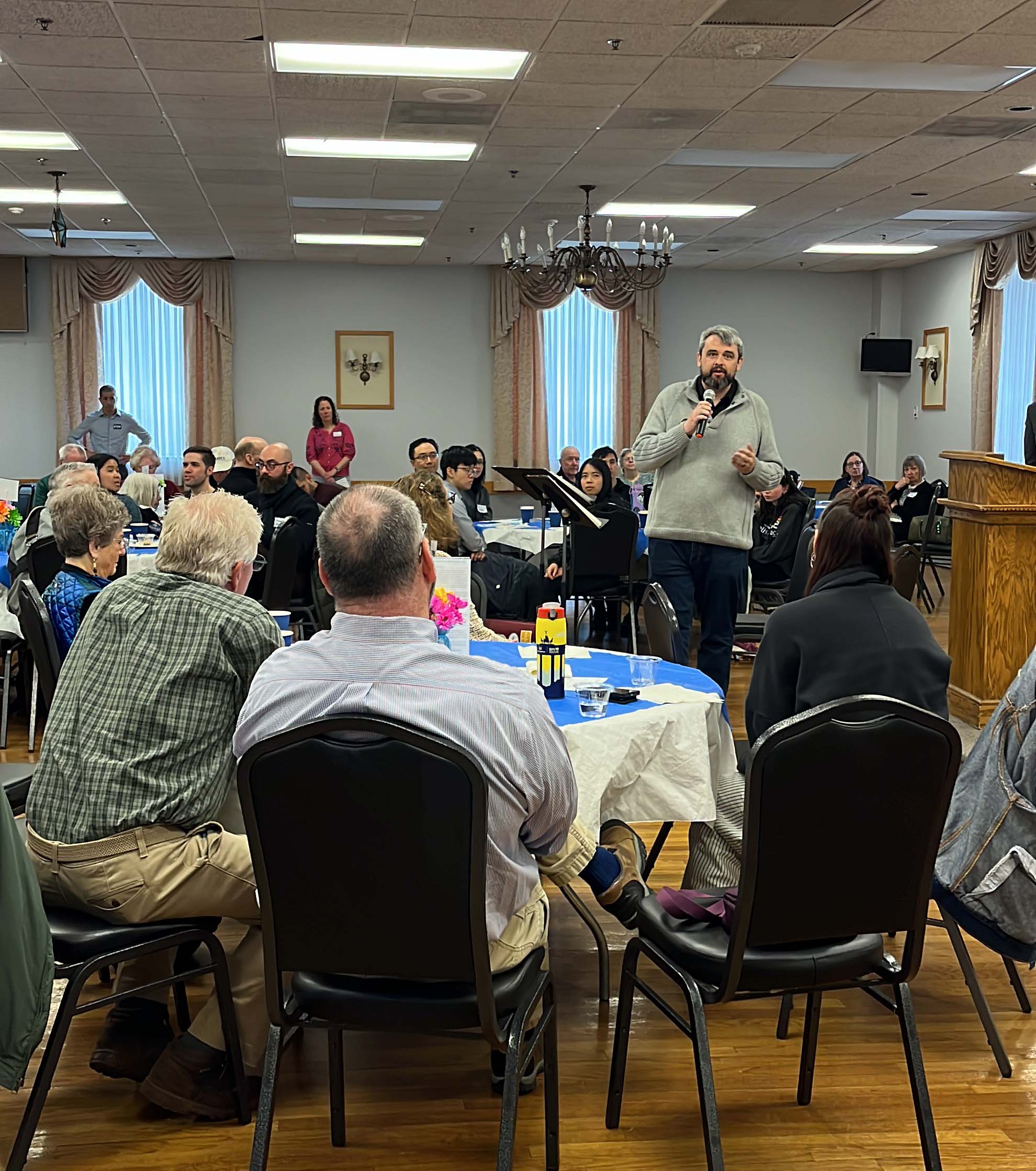
Photo From Jay Higgins
Higgins also wants to make childcare more affordable, including establishing statewide universal preschool for children aged 3 and 4. “Kids who go to preschool enter school years ahead,” he said, “and free preschool will ease the financial burden of daycare for parents and allow them to go to work and put salaries back into the economy.”
As for how to fund this plan, Higgins said, “in an ideal world, the state would pay. We don’t want to add to already overburdened municipal budgets.” Experts estimate that universal preschool would cost approximately $21,000 per pupil in new construction costs, plus $20,000 per child per year - and with approximately 150,000 children ages 3 and 4 currently living in Massachusetts, some back-of-the-envelope calculations suggest a total ongoing cost of approximately $3 billion per year, not including construction costs.
Higgins suggested that the state could use some of the Fair Share Amendment (“millionaire’s tax”), which brought in a little over $3 billion this year, although much of that funding currently goes to the MBTA, special education and early education, and local earmarks (this fiscal year, for instance, Melrose alone is anticipating $415,000 in earmarks from the Fair Share Amendment related to transportation and education). Higgins also stated that he would be open to exploring an additional wealth tax to fund a universal preschool initiative.
He also wants Massachusetts to increase the child tax credit from what he calls an “embarrassing” $400 per year to match the federal child tax credit of $2,000. “We live in one of the most expensive states,” he said, “yet our child tax credit is dwarfed by the federal credit. $2,000 could go a long way to pay for diapers, childcare, and other needs.”
Higgins is also focused on how the state could address the current housing crisis. “I want the state to step in and repeal, statewide, a lot of the restrictive local zoning laws we have that disincentivize or completely prohibit building new housing,” he said. “Governor Maura Healey said that we need to build 250,000 units of additional housing to address the housing crisis, and we are never going to get there if we don’t repeal restrictive local housing laws.”
“It’s really a multigenerational problem,” he went on. “We think of housing as a young person’s problem, that they can’t afford to buy into a community, but while seniors on a fixed income might have paid off their house, they can still feel priced out because the cost of taxes, utilities, and maintenance keeps rising. A lot of seniors are in bigger homes than they need, but it’s difficult and expensive to downsize.”
While much of the discussion around housing has been focused on building subsidized affordable units, Higgins argues that more construction statewide will lead to lower prices overall. “We want market-rate housing to be affordable for the average person,” he said, “and subsidized units to be there for people who really need them.”
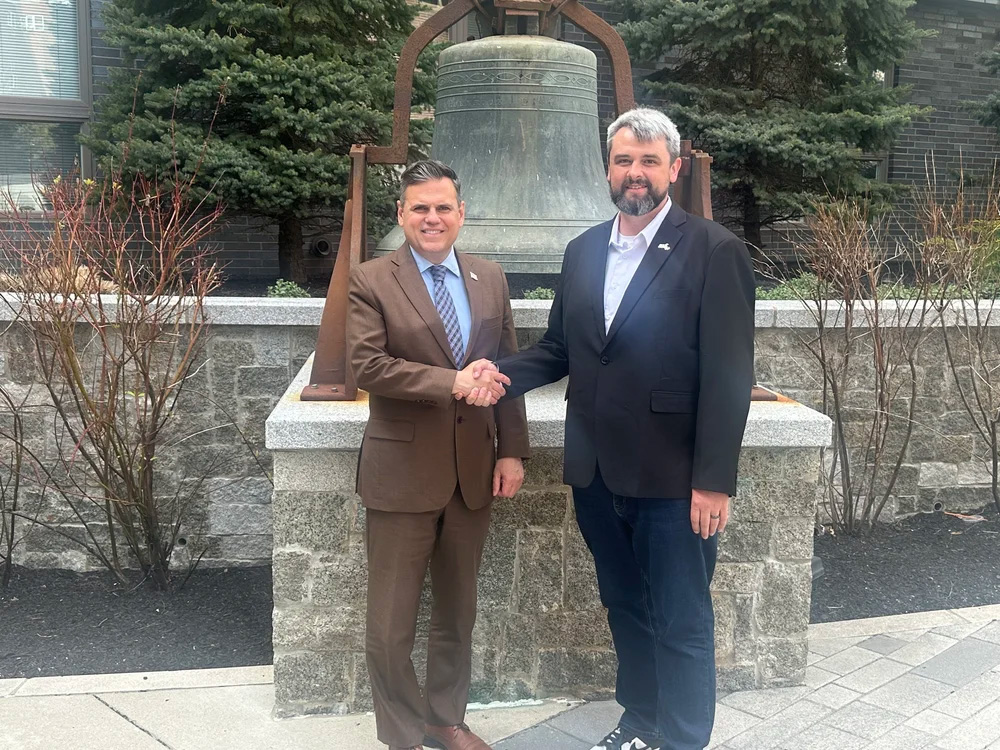
Higgins with Malden Mayor Gary Christenson
Photo From Jay Higgins
Higgins is also an advocate for accessibility for individuals with disability, a subject that is personal to him because his wife is visually impaired. “The Americans with Disabilities Act passed 36 years ago,” he said, “and we are still, in so many ways, failing on a basic level to make the community as accessible as it should be. I’m not disabled myself, but I want to be a voice for people who are fighting to make our communities more accessible and accepting.”
And Higgins wants to work on addressing current challenges with municipal funding. “One of the biggest issues that every municipality is facing right now is budget constraints due to Proposition 2½,” he said. “I agree that there should be a cap on how much municipalities can raise their tax base each year, so residents aren’t getting a surprise bill out of line with what they expected to receive. I think the concept is sound, but the problem is in putting a hard cap that doesn’t have room for nuance or account for inflation. I would like to see the Proposition 2½ cap amended to cap the increase at 2.5% or the rate of inflation for the past year, whichever is higher. Then, if a city or town wants to go above the rate of inflation, they still have to put it to a vote.”
“If we continue to force these up-and-down votes in every community across the state,” he continued, “we’re going to end up with growing educational inequality. The biggest line item in any municipality is the schools, so communities that vote to override are voting to fund their schools, and communities that don’t are voting to cut their school budget. Over time, it will lead to schools from more working class communities losing resources for their students while students from wealthier communities will go to schools with many more resources. When you think about it as a statewide policy, it will stunt our education for decades. It doesn’t meet the promise that every kid is entitled to an equal education. Tying Proposition 2½ to inflation would do a lot of good.”
Higgins also supports revisiting the formula for Chapter 70 state education aid. “The formula is very outdated,” he said, “and ends up with certain cities not getting funding they need to fund their schools. I would rather the state take a bigger role in funding the schools rather than putting it on municipal budgets. In my ideal world, each municipality would be getting enough money from the state to fund their schools at an adequate level, and if towns want to add more, they can. There shouldn’t be a town that’s struggling to fund their schools when we live in one of the wealthiest states in the country.”
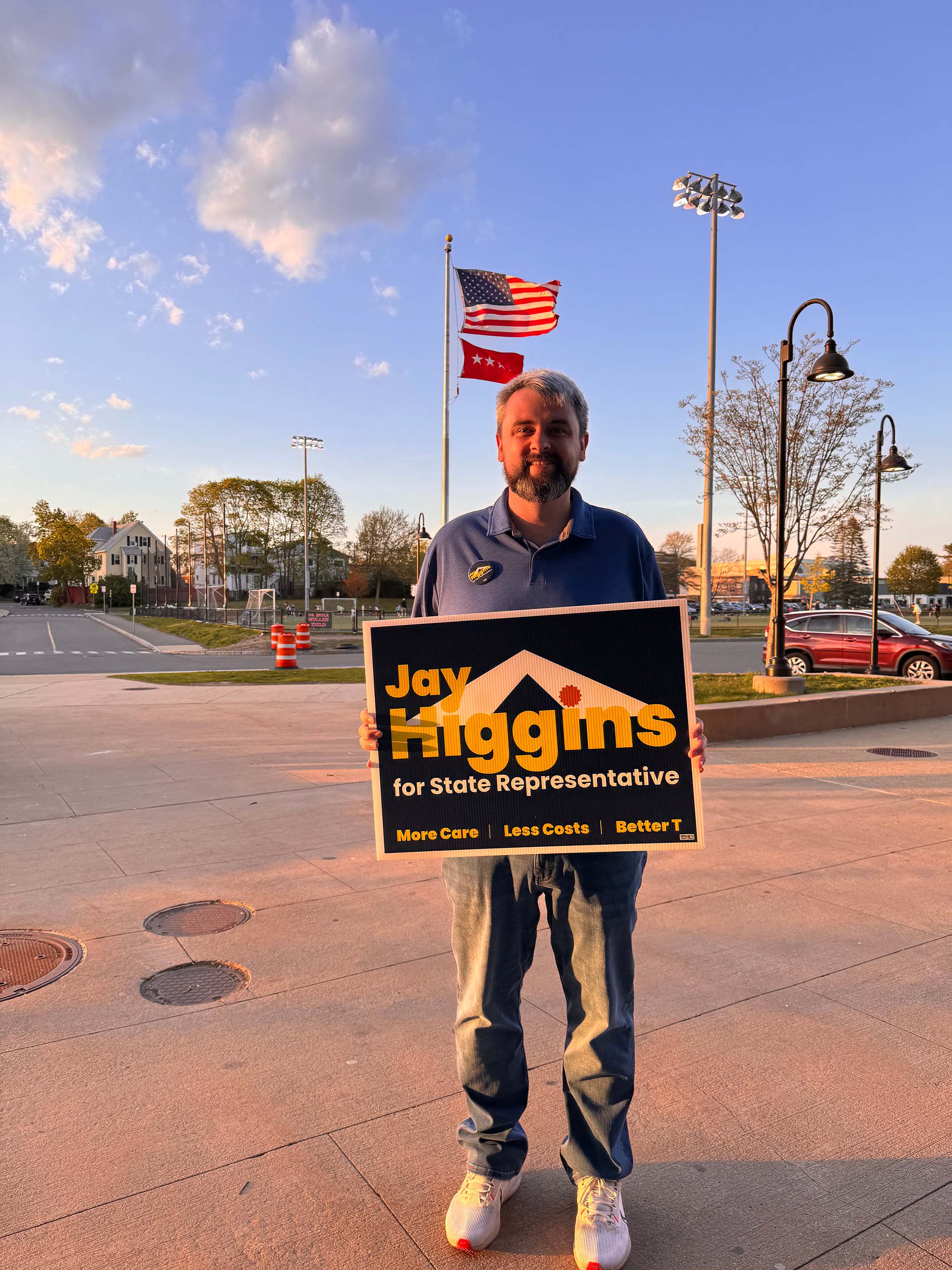
Photo From Jay Higgins
Higgins expressed strong support for the audit of the state legislature and criticized the legislature’s leaders’ approach up to this point.
“The number one thing hindering the public’s confidence in the state legislature is its obstinance to the audit,” he said. “It’s quite illogical. It makes no sense to fight this hard against an audit. I understand that they might have constitutional concerns, around checks and balances, and there might be an argument to that, but if we don’t allow a full audit to take place soon, the public is going to lose the little bit of trust they still have in the legislature.”
Higgins added that he would like to see the legislature make more of its proceedings easily accessible to the public. (While proceedings for full House and Senate sessions are livestreamed and recorded, committee hearings often are not.) “I would assume, as a representative or senator,” he said, “you would want constituents to have easy access to what you’re doing - it would make publicizing what you’re doing that much easier.”
As for his approach to legislating, Higgins said, “My approach would be to stay in as close touch as possible with my constituents, to keep my finger on the pulse of what the community wants and needs. I would always put that ahead of party politics, or pressure from leadership.”
“I believe I’m very skilled at building coalitions,” he went on, “and finding groups of likeminded people to move the ball forward. My strategy would be to work with as many legislators as possible who are focused on moving Massachusetts forward and making Massachusetts into a state that everybody can afford to live in.”
Higgins is an Air Force veteran, and lives in Malden with his wife, Kate, her retired guide dog, Dodger, and their cat, Sawyer.