‘Don’t Talk About Politics’ At Molly’s Bookstore
By Ellen Putnam
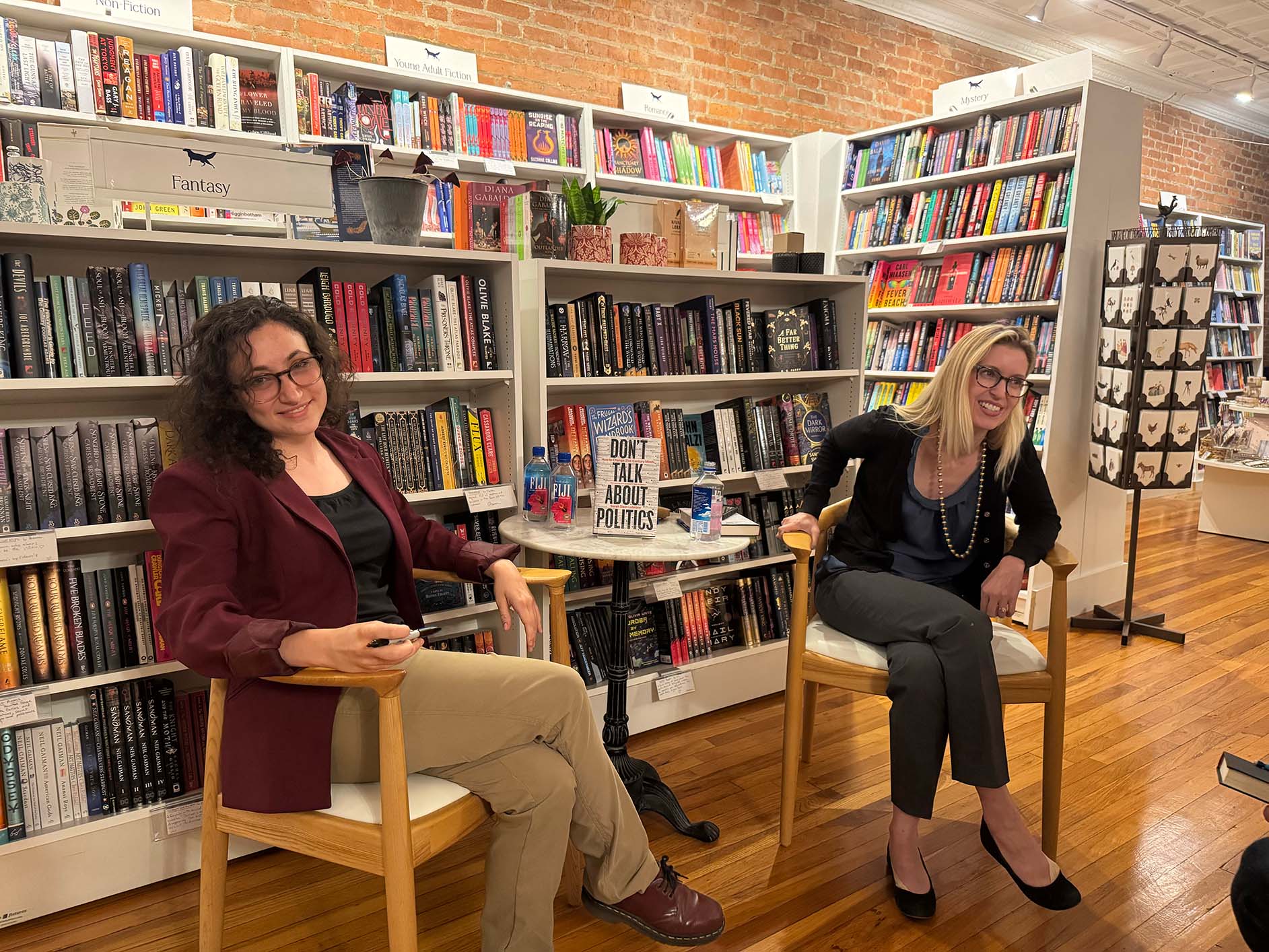
Dr Sarah Stein Lubrano, left, and Dr Bonnie Talbert
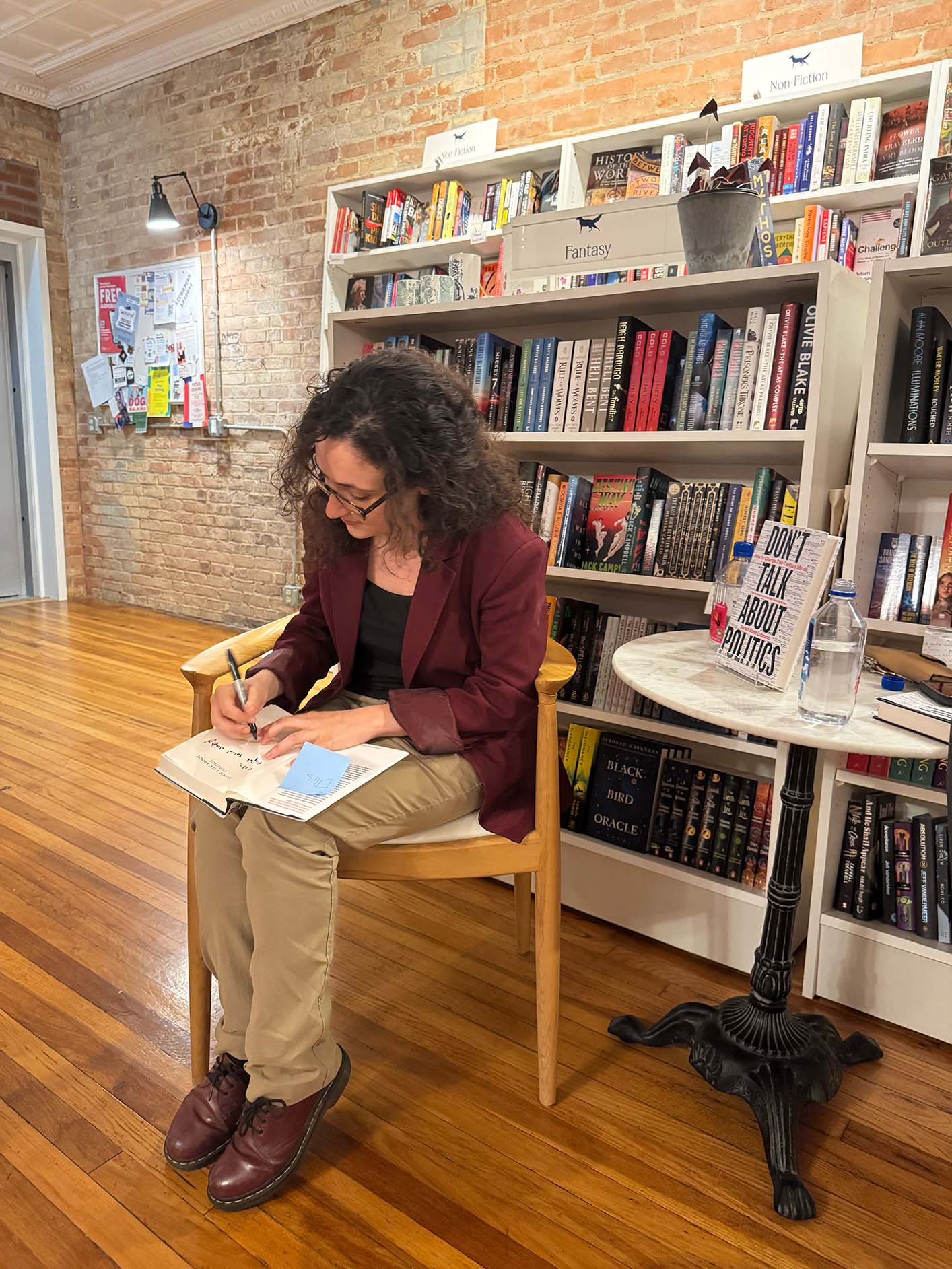
On Wednesday evening, political theorist Dr Sarah Stein Lubrano came to Molly’s Bookstore to talk about her new book, Don’t Talk About Politics. In a discussion moderated by Dr Bonnie Talbert, who had been her undergraduate advisor at Harvard, Stein Lubrano shared some of the key insights from her research.
Stein Lubrano is originally from Maryland and has degrees from Harvard, Cambridge, and Oxford. She currently lives in London, and is visiting Boston on her book tour.
In a political moment where people seem to spend endless hours fighting with one another on social media and significant focus is given to political debates, Stein Lubrano argues that debating politics doesn’t actually change most people’s minds.
“The world of political theory involves some funny assumptions about humans,” Stein Lubrano told her audience on Wednesday. “The idea is, that if people get more information, they will change their minds, so if we have more debate and more discussion and better journalism, then we will have a better democracy.”
“But I’ve always been interested in psychology,” she went on, “and there seemed to me to be a gap between psychologists and political theorists, because psychologists recognize that people are difficult to persuade - they can become deeply invested in ideas that cause them suffering, but they are unwilling to give those ideas up. People don’t tend to change their minds easily when it comes to issues that are deeply bound up in their sense of self.”
Central to Stein Lubrano’s argument is the idea that, although people are not easily persuaded by talking about politics, it is very much possible to change people’s minds. In general, she says, people’s minds can change when they take action together - and usually that needs to happen in person, not online.
“If we look at any other area of our lives, we don’t think that sitting around and talking is the most important thing,” she explained. “In a friendship, you can’t just talk - you have to be there for the person when they need you. As a parent, if you don’t drive your kids to soccer practice and help them through tough times, it’s not a real family relationship. At work, you can’t just sit around discussing things infinitely.”
“And in politics,” Stein Lubrano went on, “we can’t just sit around and talk about it - we have to do it. Doing it is how we reason through and figure out where we stand. For too long, we’ve thought about democracy as sitting around and talking, and then having an occasional vote. But so often, it’s actions that change people’s minds and not the other way around - people engage in the world and then they revise their views.”
“In the US and the UK, which I write the most about,” she continued, “we’re at a low point for social interaction. People have fewer friends, less social trust, and they spend less time with other people. They don’t actually report feeling lonelier - they’re just more alone. And that has significant impacts on how we see other people. We need relationships as a barometer for what is real in the world.”
Stein Lubrano talked about the idea of social atrophy (which, she shared, will be the focus of her next book). According to this concept, socializing is a skill that can be lost when we don’t practice it.
“Our brains are incredibly plastic,” she explained, “and they adapt to the way we use them. And the number one thing our brains are meant to do is to have social interaction face-to-face - which is actually really hard for our brains. It’s a big, complex task - you have to read facial expressions, think about what you know and what the other person knows. And when we stop doing this kind of complex social interaction, we can lose some of the social abilities we need - what’s called social atrophy. Our brains actually shrink and repurpose those neurons for other things.”
“I sometimes get what verges on hate mail,” Stein Lubrano said, “from people who say, ‘I’m an introvert, leave me alone!’ And I get it! I’ve been on book tour for months and I would love to just lie down by myself in a dark room.”
“We humans often don’t feel like going out and socially interacting because it’s a big cognitive workout for us,” she went on, “but then we feel better after we do it. There was a study that asked participants if they would like to have a 30-minute conversation with a stranger, and they all said no - the only difference between the introverts and the extroverts was that the introverts especially didn’t want to. It’s high effort, and it’s a risk. But all of the study participants felt better after they had the conversation.”
Stein Lubrano talked about the infrastructure that is required for fostering the kind of social interaction that people need in order to build a strong civil society. “It looks like bookstores. It’s third spaces - places that are neither the workplace, which is too hierarchical, nor the home, which is too private. It looks like pubs - which are all closing down in the UK. It looks like music venues, parks, libraries, the playground in front of the school.”
She noted that the decline of religious institutions, which have served this social function for many people in the past, may have contributed to social atrophy. “People on the left don’t want to hear anything nice about religion because it’s not cool,” Stein Lubrano quipped.
“Should we all go back to church?” she asked. “I don’t know, but that’s where people used to learn social skills, and learned to coexist with people they don’t like. We should probably all go to some place where you can do that. You have to learn those skills and practice them, and as a society, we’re at a low point of knowing how to do that.”
Andrea Iriarte Dent, the owner of Molly’s Bookstore, pointed out that in her native Guatemala, “the social infrastructure was non-existent, and I see how quickly we are now losing it here. I come from a place where the infrastructure was the street corner because there was nothing else. Up here, people are not like that - it’s a very different culture. You need the infrastructure in order for people to socialize.”
Building on the idea of different cultural norms around socializing, Stein Lubrano pointed out, “Here in the US, if you’re sitting next to someone on the bus for more than an hour, you’ll end up talking to them. In the UK, it’s considered rude to do that. But if you’re drunk, no rules apply - you can talk to anyone. And that’s why pubs are essential social infrastructure over there.”
“A lot of cultural norms are skill-based,” she went on, “and they depend on how comfortable you are with other people being in your space. In my opinion, the ideal is a culture where someone can knock on your door unannounced, but you can also tell them ‘not today’ without that being seen as rude.”
“It’s impossible to organize politically without lots of social interactions,” Stein Lubrano concluded, “and this has led to a lot of increasingly alone, distrustful people who don’t like their neighbors and don’t want to talk to anyone. And that’s a great way for governments to take over.”
“We’re already living in a time when a lot of people are feeling disempowered,” said Talbert. “What would you say to someone reading this who says, ‘this sounds really big, complicated, and hard?’”
“Nothing is easy,” Stein Lubrano responded, “It’s much easier to go home and watch Netflix and never have to talk to your neighbors - but why would it be easy? This is the most important thing we could be doing. Our contribution to society is living with other people and protecting the planet.”
“But the starting blocks are a little more fun than they sound,” she went on. She described her own community-building exercise: starting a food co-op in her neighborhood in London. “In order for it to happen,” she explained, “we had to go door-to-door and ask our neighbors if they wanted cheap groceries. Knocking on someone’s door is very un-British, and we had some really awkward conversations - but we recruited 17 people for our co-op.”
“We host it in someone’s living room every week,” Stein Lubrano continued, “and now we know our neighbors. Someone checks in if we don’t show up. Our lives are better for this. And it turns out, this is a great unit for political organizing: if something happens in the neighborhood, we have people we can call on.”
Stein Lubrano talked about one surprising piece of data: while, overall, people who identify themselves as on the left politically are, by a number of measures, less happy than others, people who are engaged in activism are actually much happier.
“One possible explanation,” she said, “is because feeling hopeless about a situation and not doing anything about it is really hard, and going and doing something about the world being on fire makes people happier. People seem to find two sources of meaning in their lives: your social relationships and feeling that you have agency.”
This translates to an interesting conclusion about political protests: while there is little evidence that political protests (specifically demonstrations, as opposed to boycotts or strikes) do much to change people’s minds or convince the government to change course, Stein Lubrano noted that protests are very effective at helping the people who attend them feel connected to a movement and to one another.
While talking about politics may not change people’s deeply held beliefs, “people do change all the time,” Stein Lubrano reflected. “Profound friendships, material and economic changes, their own actions - these can all change people’s views. Together, we are powerful. We do achieve things, but not through words alone and not without material change. We change people’s views through things that are way harder than arguing - way stickier and messier.”
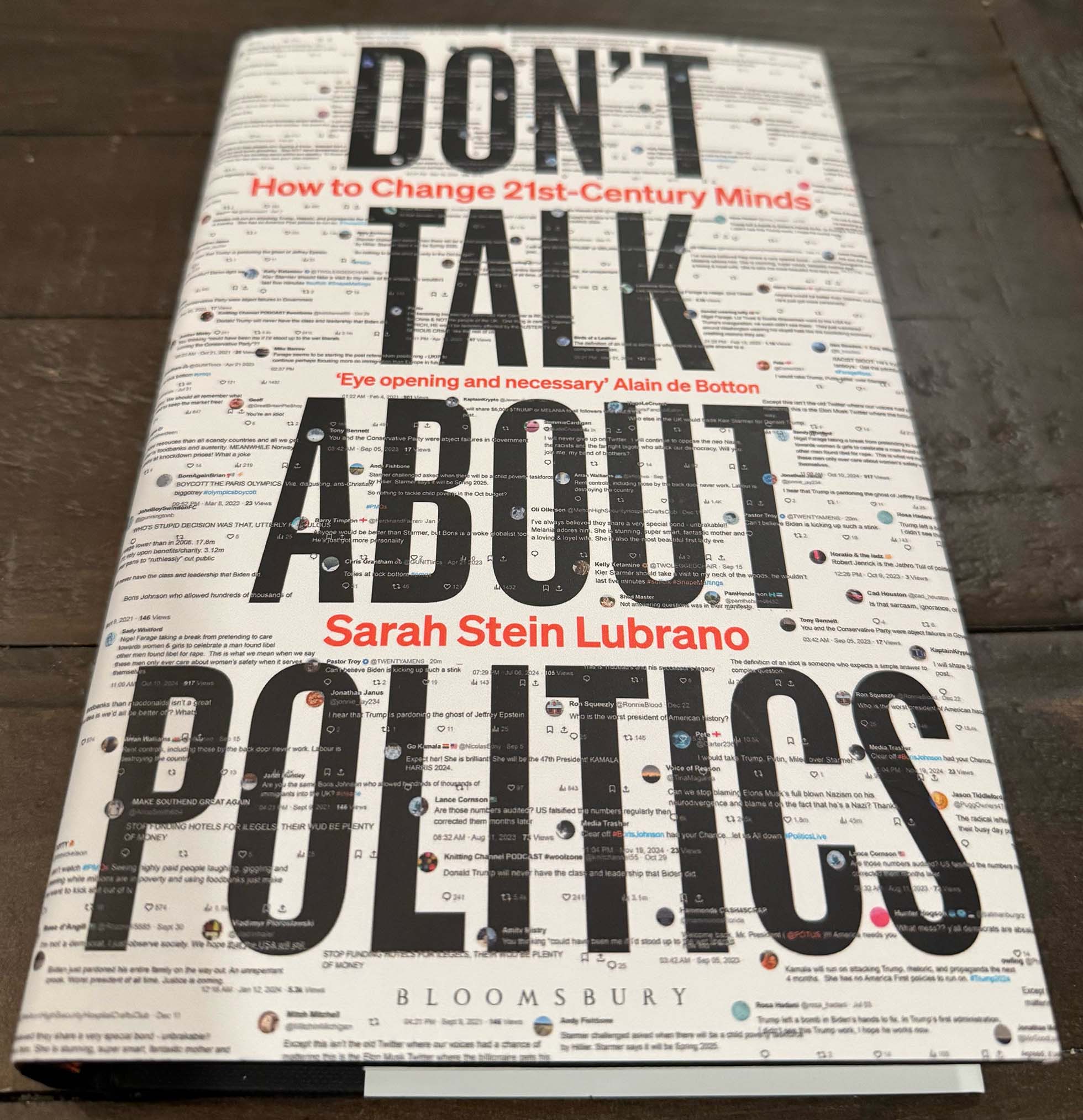
You can pick up a signed copy of Dr Sarah Stein Lubrano’s Don’t Talk About Politics at Molly’s Bookstore (while supplies last!). To learn more about her work, check out her Substack and her Instagram.
A Personal Reflection:
Sarah and I have been friends since high school, so I was delighted when I was able to connect her with Andrea at Molly’s Bookstore to talk about her new book.
There is a lot in Sarah’s work that resonates with me, as I imagine it does with many others here in Melrose (and beyond). I feel so lucky to live in a place where I feel comfortable chatting with my neighbors (shout out to the best street in Melrose!), and where finding community is as easy as going down to the Victorian Fair on Main Street (this Sunday!) or to Molly’s Bookstore for an author talk.
And yet, as I think many of us do, I also see things that threaten to tear us apart: arguing online instead of working things out in person; seeing one another as our political affiliations instead of as neighbors.
So this is the task I think is before us (and what I aim to do with The Melrose Messenger): to keep connecting with one another; to keep trying to understand one another’s points-of-view; and to keep breaking down barriers to connecting with one another. I’m excited to continue our work together as a community to strengthen the ties that bind us, even when we don’t always agree.