Amber Payne On The Future of News
By Ellen Putnam
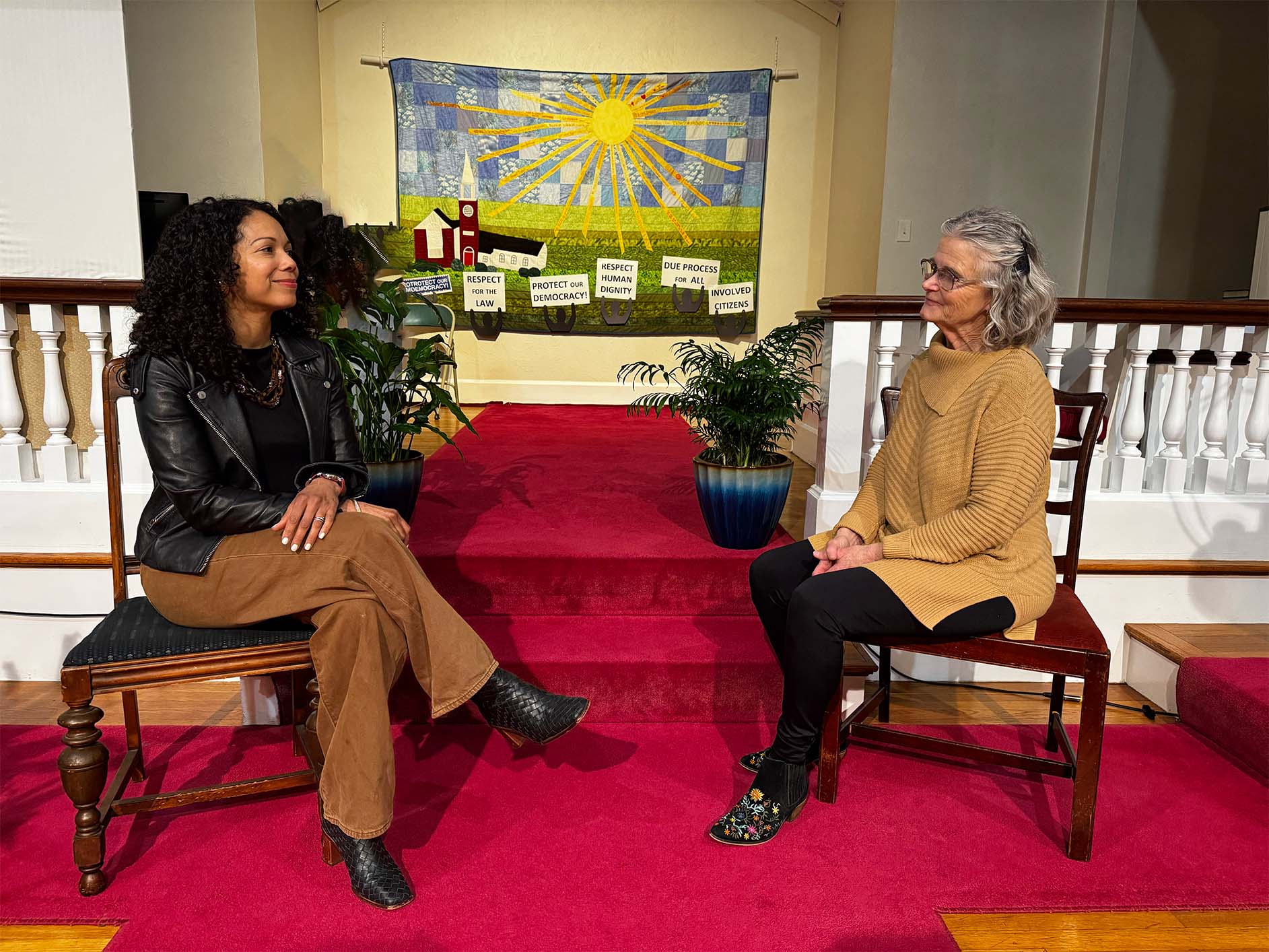
Melrose resident Amber Payne spoke last Thursday night at Melrose Unitarian Universalist Church’s (MUUC) Thoughtful Thursday on a subject that is near and dear to our hearts here at The Melrose Messenger: the future of news.
Payne has spent her career as a producer and writer in both traditional and emerging news media, with credits that include NBC News, The Emancipator, and her own documentary production company, Tilt Shift Media. She will be relocating to Denver later this year to serve as the Chief Experience Officer for Rocky Mountain PBS.
Payne reflected on her time at NBC News, where she was involved with writing what she called “the first draft of history.”
“I felt a great responsibility to report accurate facts, to speak with the right people, and to frame the story properly,” she recalled. “I was one of very few Black people in the room, and I felt that I needed to speak up.”
While NBC News offered a large platform with millions of viewers, the format also limited what Payne was able to get across. “That’s the challenge of a two-minute story,” she said. “You can’t get everything in.” And often, she reflected, when breaking news arrived at the last minute, a story that she and her team had put significant time and effort into might not receive the airtime it needed to make an impact.
In 2020, after the death of George Floyd, many major news outlets hired more reporters of color to cover stories that touch on communities of color in a deeper, more thorough way. But now, with the current top-down dismantling of diversity, equity, and inclusion (DEI) programs in the United States, those efforts are contracting and journalists of color are being laid off.
(And these changes to news media don’t just affect the stories that are told about communities of color. In the culmination of a decades-long trend of larger corporations buying up local news media, now even large newspapers like The Washington Post are seeing a decline in coverage due to widespread layoffs and corporate interests.)
Payne referred to the words of journalist Delano Massey, who said, “Whenever the country’s foundational truths surface — racial, historical, or structural — newsrooms retreat, and coverage collapses at the very moments honesty is required. When 2020 forced newsrooms to confront institutional racism, the honesty lasted only as long as the pressure did.”
But, Payne reflected, even as traditional news media are retreating from serious, in-depth coverage of stories that affect communities of color, new technology and platforms make it easier for independent journalists and content creators to tell stories that don’t appear in traditional media.
“The media landscape has changed,” she said. “There are lots of great people out there, doing their own thing.”
Payne talked about her work with The Emancipator, which aimed to bring in social media audiences by offering analysis on Instagram, often in partnership with popular creators (fact-checked by the reporters), and then running longer-form articles on their site. “It’s like having your friend explain things to you in real words,” she reflected.
Part of what Payne believes makes many traditional news stories incomplete is the lack of historical context. As a documentary filmmaker at Tilt Shift Media, which she co-founded with her husband, Rayner Ramirez, she has been able to delve deeper into the topics they cover.
Their documentary, Harlem Rising, is about the Harlem Children’s Zone, which is also shown in the documentary Waiting For Superman. But Payne’s goal in the documentary was to share more of the historical context, including, she noted, the redlining and discrimination that led to Harlem becoming a majority-Black neighborhood in the first place.
And in their documentary, Avenues of Dreams, Payne and Ramirez explored two Martin Luther King, Jr. Boulevards in Baltimore and St Louis, which had become known as centers of violence and poverty.
In the film, they highlighted activists who were working to improve their neighborhoods. “We believe in the importance of asset framing instead of poverty porn,” Payne said. “We need to lead with the humanity of a place or person.”
“I’m constantly learning,” Payne added. “That’s what I love about this job.”
If you’re feeling inspired to support local news media, you can support The Melrose Messenger by reading and sharing our stories! We don’t have a financial structure, so if you’d like to donate to local journalism, consider donating to a publication like The Bay State Banner, which Payne highlighted as a local, long-lived African American-owned newspaper based in Roxbury.