City Council Approves Fiscal Year 2027 Budget
By Ellen Putnam
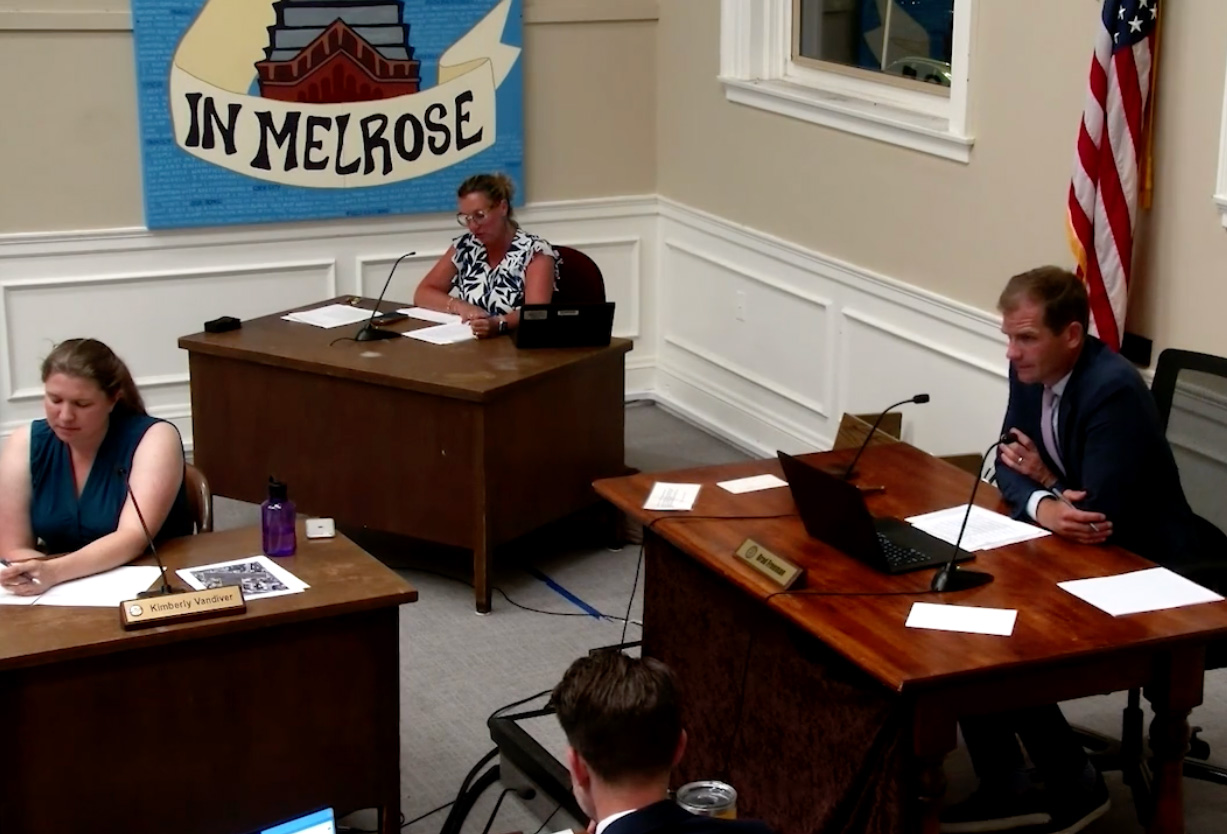
City Council President Brad Freeman, right
Screenshot from MMTV
The City Council wrapped up its annual budget process this week by approving the city budget for Fiscal Year 2027 (FY27, which begins on July 1st) and a number of free cash expenditures from last year’s budget.
In each of the last two years, the budget process was focused on where cuts could be made to make up an approximately $6 million deficit, which was caused by the fact that the revenue the city is legally allowed to collect was not keeping pace with rising costs. Thanks to funds from the $13.5 million override that voters approved in November, this year’s budget process instead saw the City Council overseeing where additional funds could be added back into the city budget.
The override funds allowed for road and sidewalk repairs to return to the regular budget (instead of relying entirely on road bonds and free cash). And new this year, the budget contains a dedicated $2 million in capital outlay for a variety of projects at city buildings, schools, and parks, as well as replacing equipment and vehicles for public safety officers.
Override funds also allowed for the restoration of 17 positions in the schools (out of over 40 that were cut over the last two years); 5 positions at the Department of Public Works; and 2 police officer positions. They allowed for smaller adjustments, such as the restoration of training and professional services budget lines that had been cut in many City Hall departments last year. And the Health Department was able to enter into a joint agreement with Stoneham and Wakefield for a shared animal control officer - a position that Melrose residents had been requesting for years.
The override funds also allowed the School Committee to successfully negotiate new three-year contracts with teachers and paraprofessionals that appear to be generally agreeable to all parties. And, perhaps most significantly, the additional funds meant that no budget cuts needed to be made this year, even as fixed costs such as benefits and contractual salary increases continue to rise and state aid appears likely to increase by less than 5% this year.
Click here for a closer look: How have override funds been used so far?
The $13.5 million override that Melrose voters approved in November 2026 is a permanent increase in the property taxes that the city is legally allowed to collect, retroactive to the start of FY26.
The override question that voters approved read as follows:
- 1A. Shall the City of Melrose be allowed to assess an additional $13,500,000 in real estate and personal property taxes for the purposes of funding: 17 school, 5 public works, and 2 police officer positions (salaries and benefits); city and school employee union contracts and benefits; school technology and curriculum needs; public works, senior center, veterans services, and library programs; and repairs and maintenance to roads, sidewalks, buildings, and parks for which the monies from this assessment will be used for the fiscal year beginning July 1, 2025?
Soon after the override passed, the City Council approved a supplemental budget that dedicated funds to each of the categories laid out in the override question.
In the FY27 budget, the override funds have been added to the general fund, instead of being pulled out in a supplemental budget, but you can get a general sense of where the override funds went this year by looking at the overall increase from the original FY26 budget to the FY27, minus debt exclusion funds, which totals $16.5 million ($13.5 million in override funds plus the 2.5% increase permitted by state law).
Here are what the supplemental budget and the increase from FY26 went to, broken down by category:
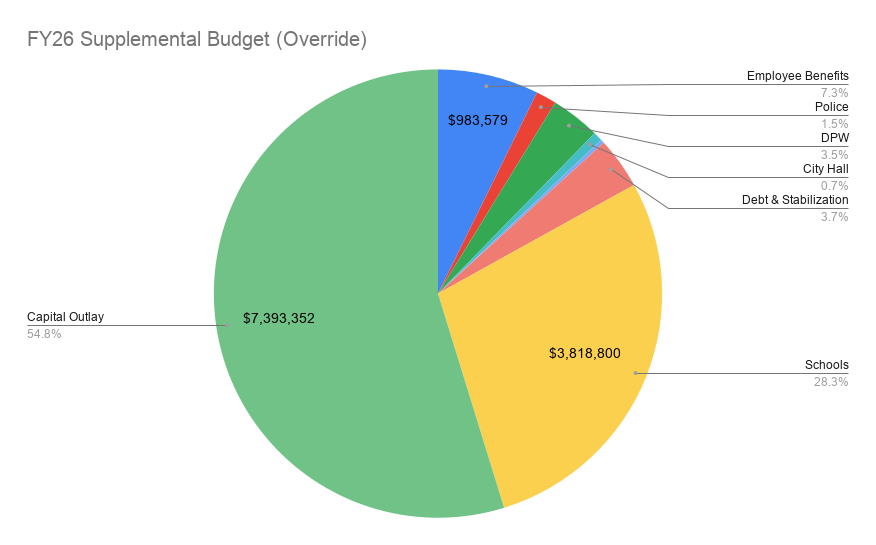
FY26 Supplemental Budget by category
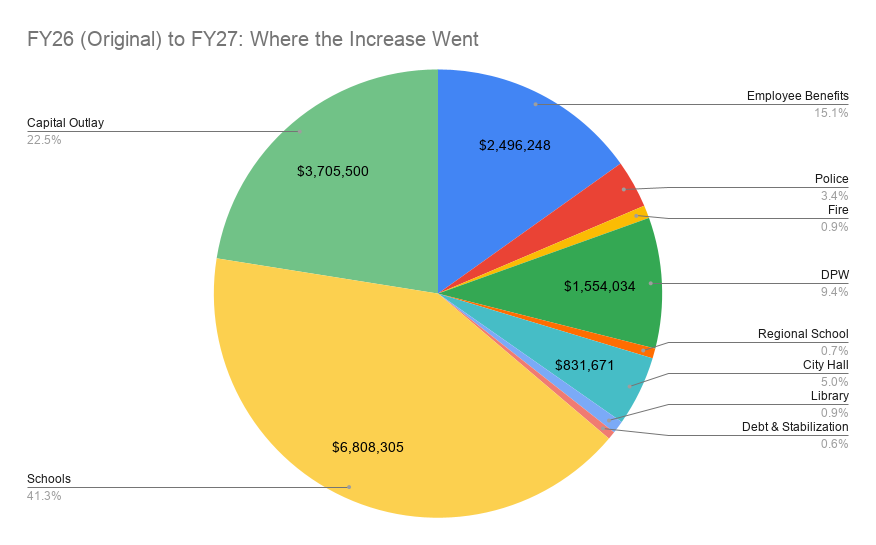
FY26 (original) to FY27 Budget Increase by category (override funds plus 2.5% increase)
And here are the supplemental budget and the increase from FY26, divided into salary costs, capital expenditures (construction projects, road work, equipment, etc), and other:
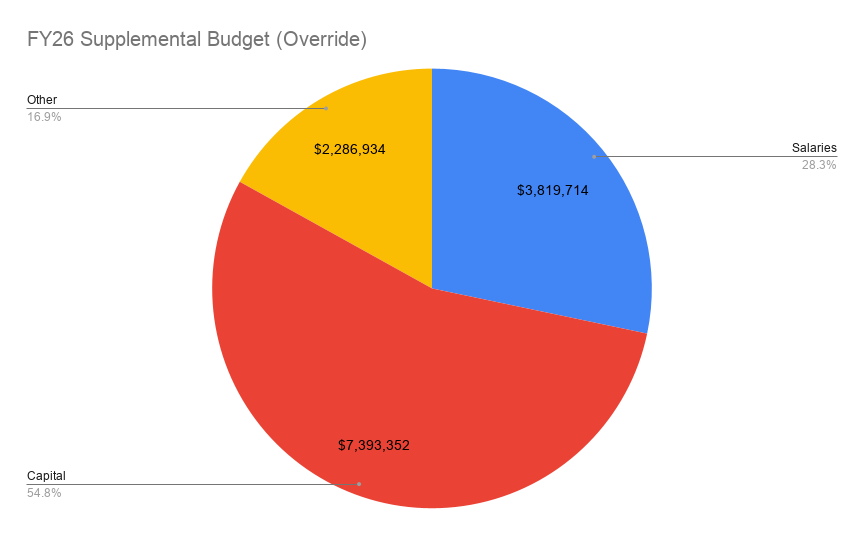
FY26 Supplemental Budget
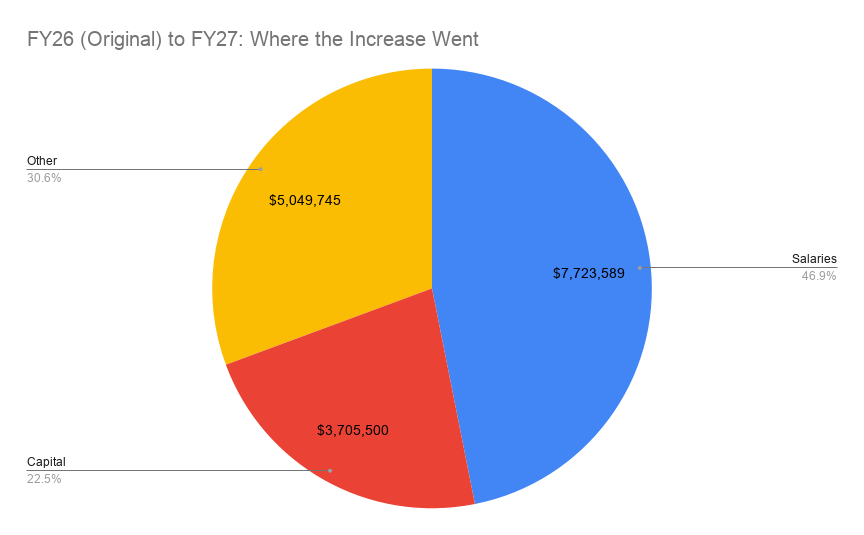
FY26 (original) to FY27 Budget Increase
You may notice that, while over 50% of the FY26 supplemental budget went to capital expenditures, that percentage dropped to only 22.5% of the increase from FY26 to FY27. That is because salaries and fixed costs like employee benefits increase each year by more than the 2.5% the city is allowed, by law, to increase property taxes. The city put the override request forward with the goal that it would cover those increases through at least FY29, averting the need for another override request before then.
Accordingly, we will continue to see salaries and fixed costs taking up a larger percentage of each subsequent year's increase, and discretionary spending like capital projects taking up less each year.
With the city’s budget currently in a stronger position, department heads are now catching up with maintenance that had been deferred, in some cases for years.
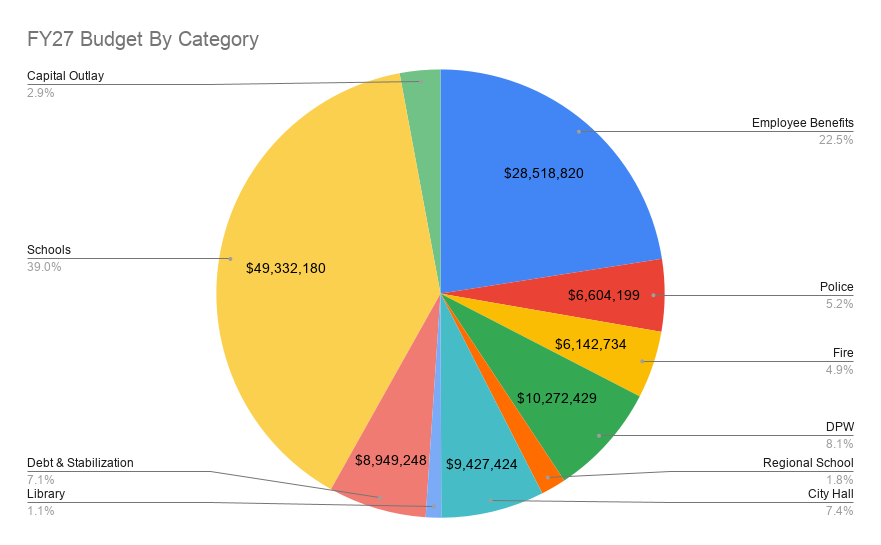
FY27 Budget by Category
Department of Public Works (DPW) Director Elena Proakis Ellis noted that a consultant has recommended that Melrose spend $1.1 million on its DPW vehicles each year to maintain an industry-standard replacement schedule.
“We’re a very frugal bunch,” she reflected, “and we like to run our equipment as long as we possibly can. A lot of communities have shiny new equipment every eight to ten years, but that hasn’t been the way we do things. We really try to keep everything running as long as humanly possible. But we are now at the point where we have trucks with literal rot all the way through the floor of the trucks. They’re barely passing inspection.”
To fill some of this gap, the City Council approved over $1 million this year in free cash expenditures for DPW vehicles, including new dump trucks and pickup trucks to replace aging vehicles and a new sidewalk plow that can also be used for brush clearing.
But while the DPW is now funded for the staffing levels they had maintained prior to last year and overtime budgets have been restored, the department is still not back to full capacity. The City Engineer position, which is responsible for overseeing larger projects and applying for grant funding, remains unfilled due to a lack of qualified candidates.
The Melrose Police Department appears to be on track to be fully staffed again soon, with two new hires advancing through the months-long training process required for new police officers, and overtime costs appear likely to remain within budget this year.
But the Melrose Fire Department, which has historically struggled with overtime costs, overran its overtime budget and required a free cash appropriation of $400,000 to cover this year’s overtime, in addition to the $489,300 that had been budgeted for this year. Chief John White explained that, while the shift to a private ambulance service last year has significantly brought down the number of forced holdovers in the department, the Fire Department does not have enough staff to cover vacation time or medical leaves without falling back on overtime - and there are no plans for increasing staffing in the department any time in the near future.
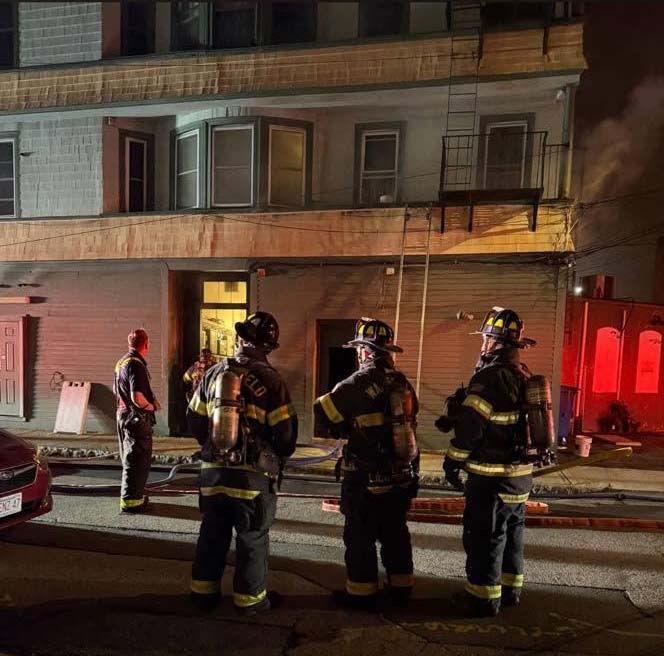
Photo From Melrose Firefighters IAFF Local 1617
The current staffing situation also means that, in some recent fires that the department has dealt with, they have needed to rely on mutual aid partners in order to have enough firefighters present to safely fight the blaze. (Similarly, Melrose is often called to assist mutual aid partners, and needs to have firefighters and apparatus ready for when a mutual aid call comes in.)
Chief White also noted that, while replacement of fire apparatus (for almost $3 million) is listed at ranking #11 in the Capital Improvement Plan, it was not funded in this year’s budget, pushing back the timeline for replacement of Engine 3 (which is 16 years old) and backup Engine 4 (which is 19 years old). Industry standard calls for engines to be removed from frontline service at 15 years old and retired at 25 years old. Chief White anticipates a three-and-a-half-year wait between ordering new fire apparatus and the delivery of a new vehicle. But the purchase of new vehicles may need to wait until the new Engine 2 building on Tremont Street is completed (currently projected for the end of 2027) in order to ensure there is sufficient space available to store a new engine.
Memorial Hall, which became a flashpoint in last year’s budget discussions when then-City Councilor Ward Hamilton proposed eliminating its budget, did not appear to spark controversy this year. Councilors voted to approve the budget, which included HVAC repairs as well as a free cash expenditure to support replacing the building’s boiler. And while the city still spends more on Memorial Hall than it receives in rental revenue, several councilors expressed their support for Memorial Hall as a city institution that they believe is worth the additional expenditure for the services it provides to the community and the customers it brings to nearby businesses.
Councilors also brought up Memorial Hall’s aging facilities, including peeling plaster on the interior of the building. The Friends of Memorial Hall has raised funds for the restoration of the Grand Army of the Republic Room (on the second floor), but according to Executive Director Kathy Pigott Brodeur, that project cannot proceed while the City Engineer role remains unfilled and no one at the DPW is available to take the lead on the project.
More changes could be on the horizon for Memorial Hall: the city received a grant last year for a study to examine possible changes to Memorial Hall’s business model, and the results of that study are expected very soon.
A number of free cash requests this year stirred up significant discussion in the City Council, and this week’s full City Council meeting resolved a number of those outstanding requests. (Free cash is what is left over from the previous year's budget and is recommended for one-time expenditures.)
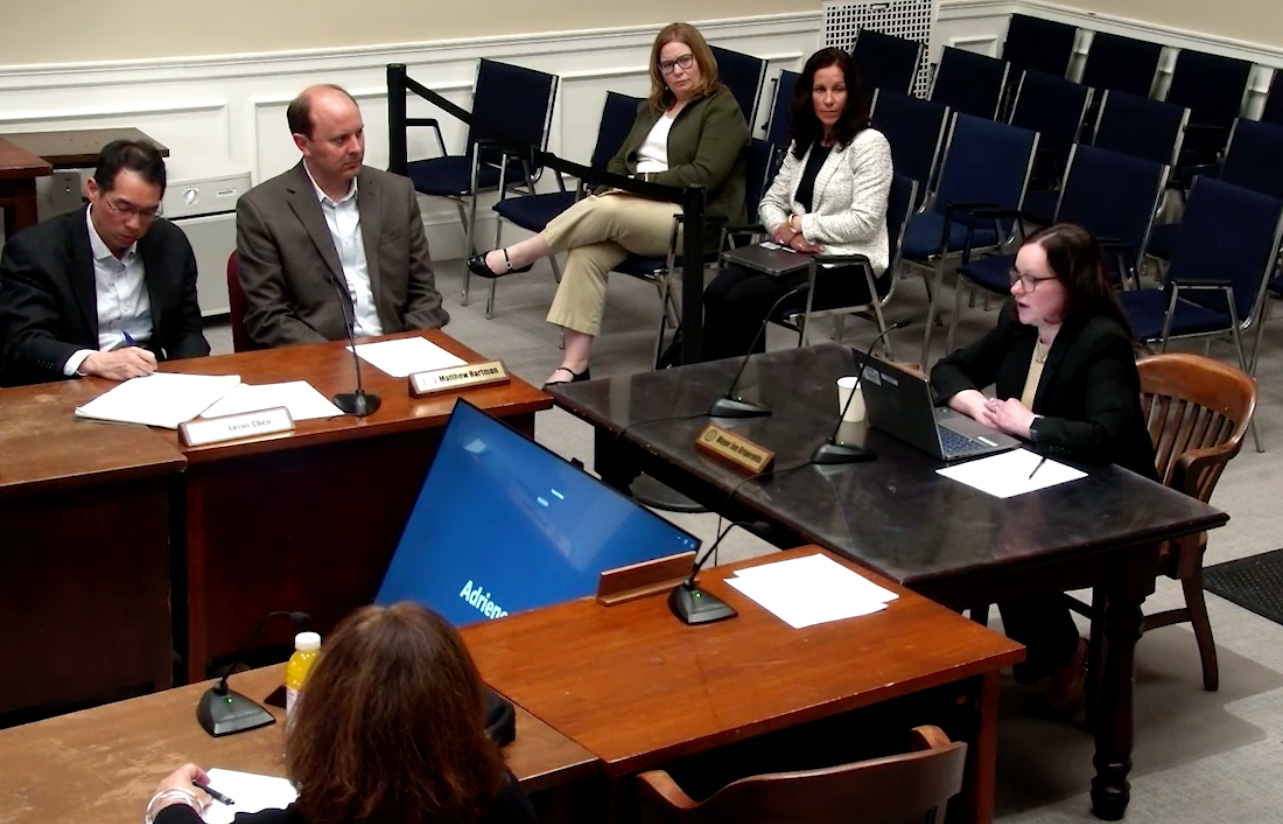
Many votes mirrored those that had been taken previously in the Appropriations and Oversight Committee; but an appropriation of $150,000 in free cash for the Affordable Housing Trust Fund, which had appeared likely to fail, ended up passing when three councilors - Cal Finocchiaro, Elizabeth Kowal, and Christopher Park - changed their votes to “Yes,” leaving only Councilor Jason Chen in opposition.
The appropriation received support from residents during public comment, and several councilors noted that they had discussed the appropriation with community members and with City Planner Lori Massa, and concluded that the free cash expenditure would provide the Affordable Housing Trust Fund with some funding to get up and running, and signal that Melrose is willing to invest in affordable housing.
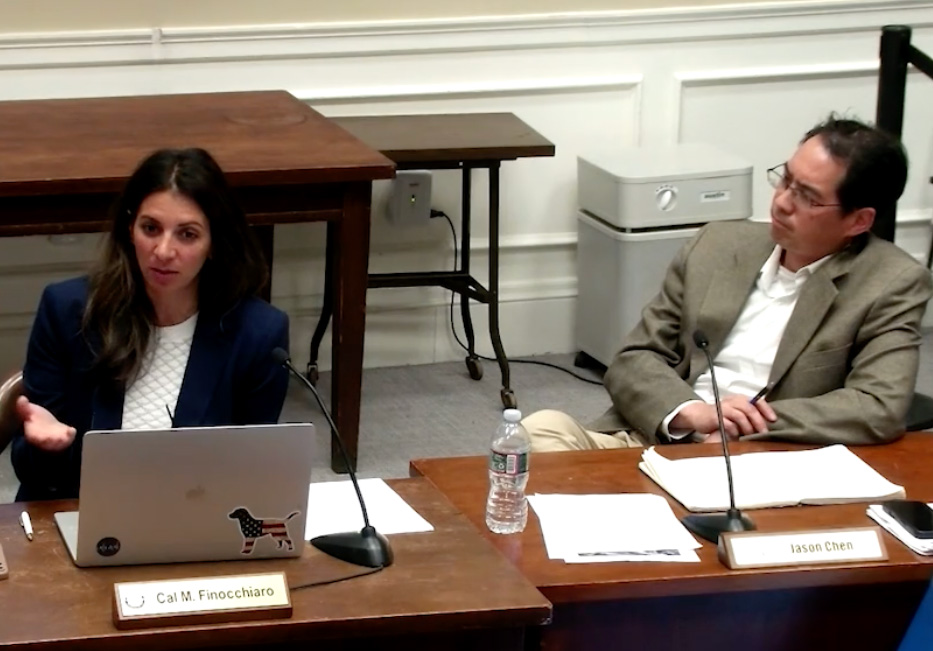
Councilor Cal Finocchiaro, left, and Councilor Jason Chen
Screenshot from MMTV
The City Council also approved a resolution introduced by Finocchiaro to support the audit of the state legislature championed by State Auditor Diana DiZoglio. DiZoglio pushed for the 2024 ballot question (approved by 72% of Massachusetts voters), which allows her to audit the legislature. Some state legislators have pushed back against the audit, arguing that the ballot question was unconstitutional and violated the independence of the legislative branch from the State Auditor’s office (which is part of the executive branch).
Earlier this month, the state House of Representatives voted to allow the audit, but with some limits, and to allow residents to request some state records that are currently inaccessible. The measure was supported by 125 House Democrats, including Melrose’s representative, Kate Lipper-Garabedian, and was opposed by three Democrats and all 25 House Republicans, some of whom stated they believed it reflected an unlawful attempt to place limits on the ballot question passed by voters. It is unclear whether the Senate will take up this bill.
Ten City Councilors supported Finocchiaro’s resolution in favor of the audit, some noting that Melrose already engages in transparency at the local level, including making all budgets and committee hearings public. The sole dissenting vote, Councilor Maya Jamaleddine, expressed concern about what some see as DiZoglio’s political motivations in her attempt to audit the legislature.
The resolution the City Council passed stated: “The Melrose City Council affirms its support for accountability, public trust, and the principle that all elected officials and public institutions entrusted with taxpayer resources should be answerable to the public they serve; and the Melrose City Council recognizes and supports the expressed will of Massachusetts voters as reflected in the passage of Question 1; and the Melrose City Council encourages state leaders and public officials to work in good faith to ensure that accountability, openness, and public trust remain central to the operation of state government.” The final resolution will be shared with the legislature and with Melrose’s state delegation.
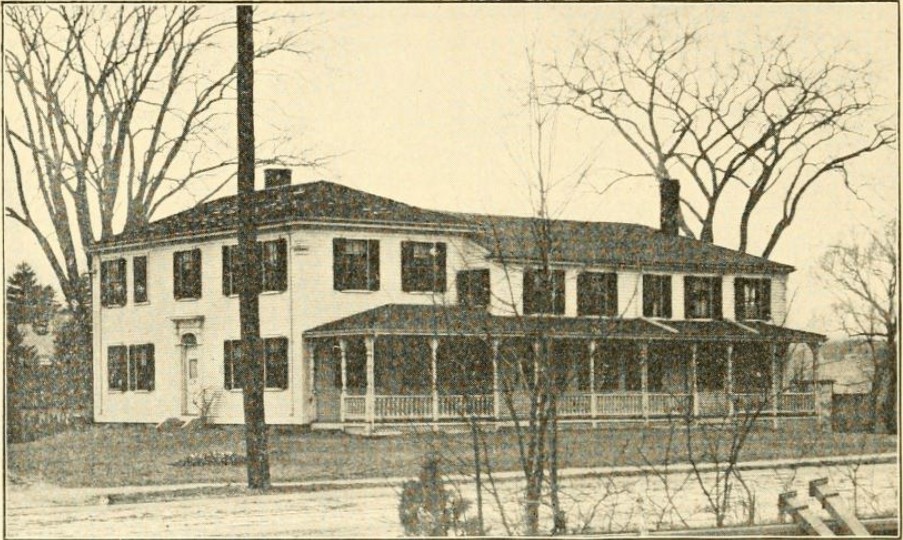
The Benjamin Lynde House
From the Melrose Historic Commission
The City Council also gave final approval to adding the Benjamin Lynde House at 244 Main Street to the city’s Historic District, which encompasses a block on either side of Main Street from Emerson to Foster Street. This would prevent changes to the historic building without the approval of the city’s Historic District Commission.
The effort to add the Benjamin Lynde House to the city’s Historic District began when the house went up for sale late last year and appeared likely to be purchased by a developer. At the time, city officials noted that other historic buildings in Melrose could also be added to the Historic District, as a way to preempt owners making changes to the buildings without city approval. This is in addition to the demolition delay ordinance the City Council approved in December.
While making the house part of the city’s Historic District has the potential to prevent or delay most changes to its exterior, the developers who expressed interest in purchasing the house, Sean and Laura Szekely of Szecon Development, appear likely to develop it under state housing law Chapter 40B, which allows developers who agree to include 25% or more affordable housing to circumvent local rules - including historic district designations.
The developers have expressed the desire to move the historic house to the front of the property and preserve it, partly as public space, and build a large residential building behind it - and if they file those plans under Chapter 40B, they would not need the approval of the Historic District Commission to build.