City Council Discusses Police Use of Flock Cameras in Public Hearing
By Ellen Putnam
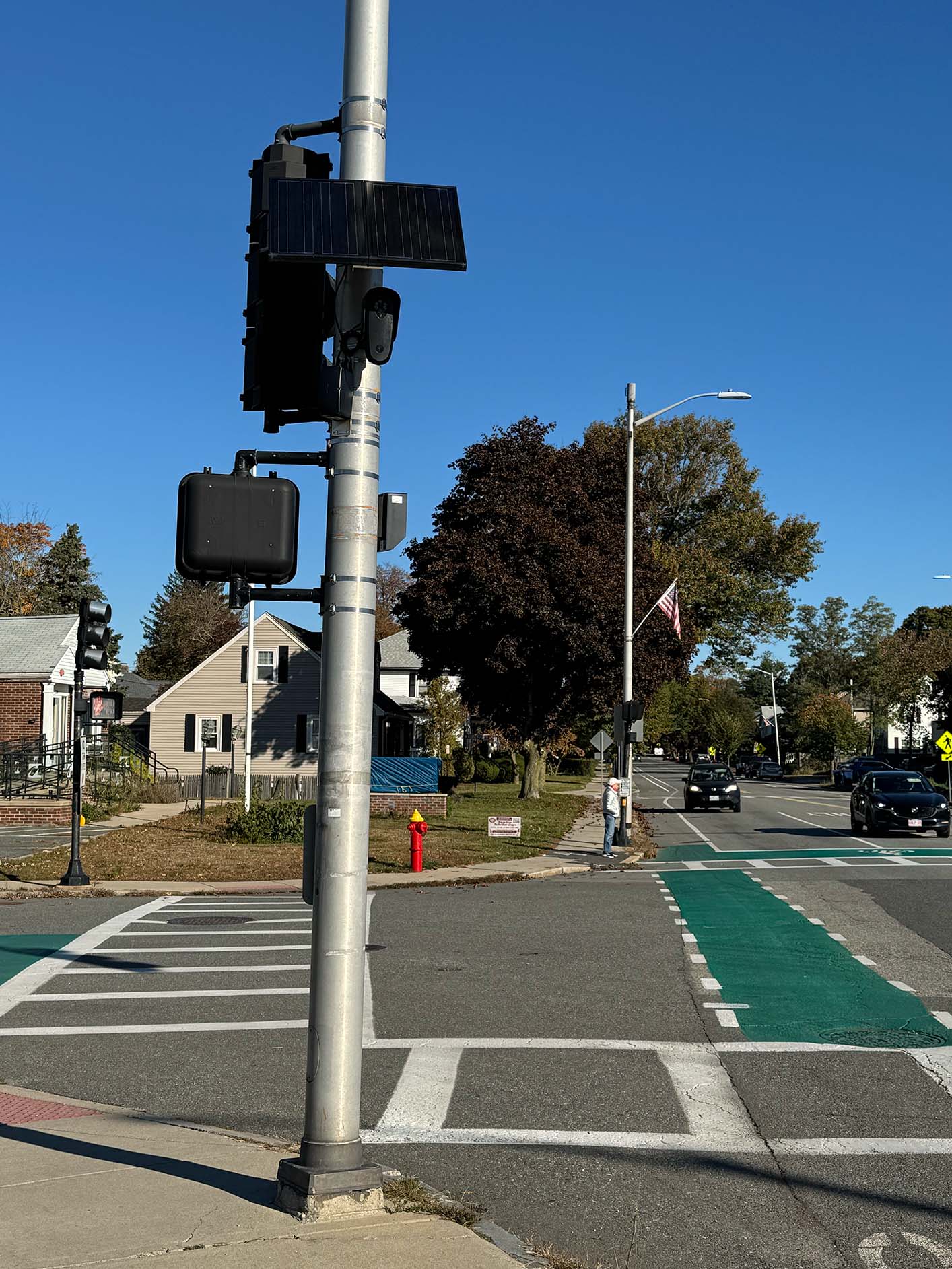
Flock camera near Pine Banks Park
Last week, the Melrose City Council held an informational hearing to discuss the Melrose Police Department’s use of Flock cameras - a technology that has come under scrutiny in recent months in Massachusetts and nationwide.
Flock Safety is one of several companies that market Automated License Plate Reader (ALPR) technology to law enforcement agencies across the country. There are three Flock cameras in Melrose operated by the Melrose Police Department (MPD), all located on Main Street: one near Pine Banks Park, a second near Ell Pond, and a third near the Wakefield border. DeFlock Maps indicates that there is a fourth, privately operated camera located near MelroseWakefield Hospital.
Police departments contract with Flock to install cameras at fixed locations. The cameras take photographs of every vehicle that drives past. Those images are stored in a system that automatically analyzes their license plate number as well as information about the car such as model and color. Officers can then search the system for a specific plate number or vehicle description, and the system will return still images of vehicles that match that description within a particular time frame, along with the time and location of the camera the vehicle passed. Depending on which other departments or agencies information is shared with, a search could turn up images from another town, or even another state.
The Melrose Police Department entered into a contract with Flock Safety in 2020, and pays $3,000 per year for the contract. (The department’s total budget this year was $1.75 million.) Because the contract is less than $10,000 per year, it does not require approval from the Mayor or the City Council outside of approval of general categories of expenditures during the annual budget process.
The American Civil Liberties Union (ACLU) of Massachusetts has raised concerns about Flock cameras, including whether the ability to track drivers from one camera to the next without a warrant violates the Fourth Amendment right to freedom from unreasonable search and seizure.
The ACLU of Massachusetts also stated that Flock Safety “has been credibly accused of violating basic cybersecurity standards, misleading local officials, and shrugging off basic democratic oversight by failing to remove or deactivate cameras after local governments have directed police to stop using Flock LPRs.” There are also concerns that the cameras may be used for immigration enforcement, stalking former romantic partners, or surveilling nonviolent protests.
Last week’s hearing came out of an informational order co-sponsored by four city councilors and supported by others. For an informational order, relevant city employees are required to appear before the City Council to answer questions. There is no further action that directly stems from an informational order, although councilors may subsequently decide to introduce legislation based on what they learn during the hearing.
“I was profoundly moved by the abuses of the technology,” reflected City Councilor Ryan Williams, one of the order’s co-sponsors, “particularly by the Trump administration, and I felt compelled to give voice to the anxiety that people are feeling.”
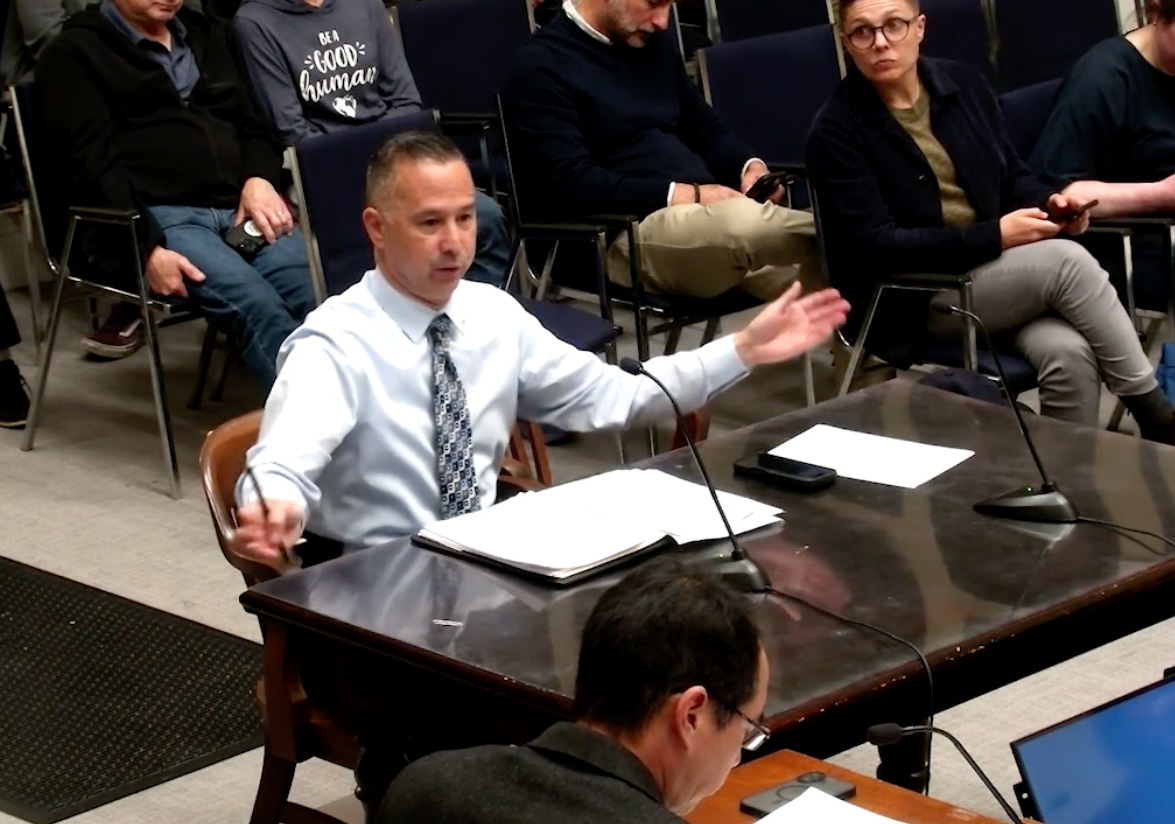
Chief Faller at last week's hearing
Chief Kevin Faller of the MPD, who answered city councilors’ questions during the hearing, explained that, according to the documentation provided by Flock, images of license plates captured in Melrose are only searchable by the agencies MPD has decided to share them with, and only for a set period of time before they are deleted. MPD has elected not to share images with any federal agencies.
Chief Faller argued that the Flock cameras have improved policing in Melrose and allow the department to solve cases faster. He referenced several cases, which are listed on the department’s Flock information portal, including a hit-and-run earlier this summer where a pedestrian was struck and injured, and the only vehicle description officers received was of a silver or gray minivan. Although surveillance cameras from nearby businesses also helped to track the suspect, Chief Faller stated that he believes that the case likely would not have been solved without the use of ALPR technology.
“Everything has evolved,” Chief Faller reflected. “I’ve been doing this for 32 years, and when I started, we didn’t even have email. We didn’t have Internet. I think it would be a disservice to the community and the people who work for me to handicap them and to take away a tool that I think is working successfully.”
One open question around ALPRs is whether they constitute an ‘unreasonable search’ under the Fourth Amendment. In 2020, the Massachusetts Supreme Judicial Court ruled that ALPR data from the Bourne and Sagamore bridges could be admitted into evidence because the information from those cameras provided only a “limited picture” of the defendant’s movements. However, the justices noted that, should more cameras come into use over time, the resulting “mosaic” could violate a defendant’s Fourth Amendment rights (which could result in that evidence being inadmissible in court, and potentially, an entire case being thrown out).
“What is a search, in the world we live in?” Chief Faller asked. “Do we have an expectation of privacy in public? Courts have said ‘no.’ Do we have a reasonable expectation of privacy in Massachusetts on our license plates? License plates are the property of the Commonwealth of Massachusetts. An officer can run a license plate at any time, for any reason.”
Reflecting on the possibility that ALPR information might at some point become inadmissible as evidence, Chief Faller added, “We have to adapt. Policing changes as the laws change. I would never put our people in a position where they’re doing anything that’s not legal at that time.”
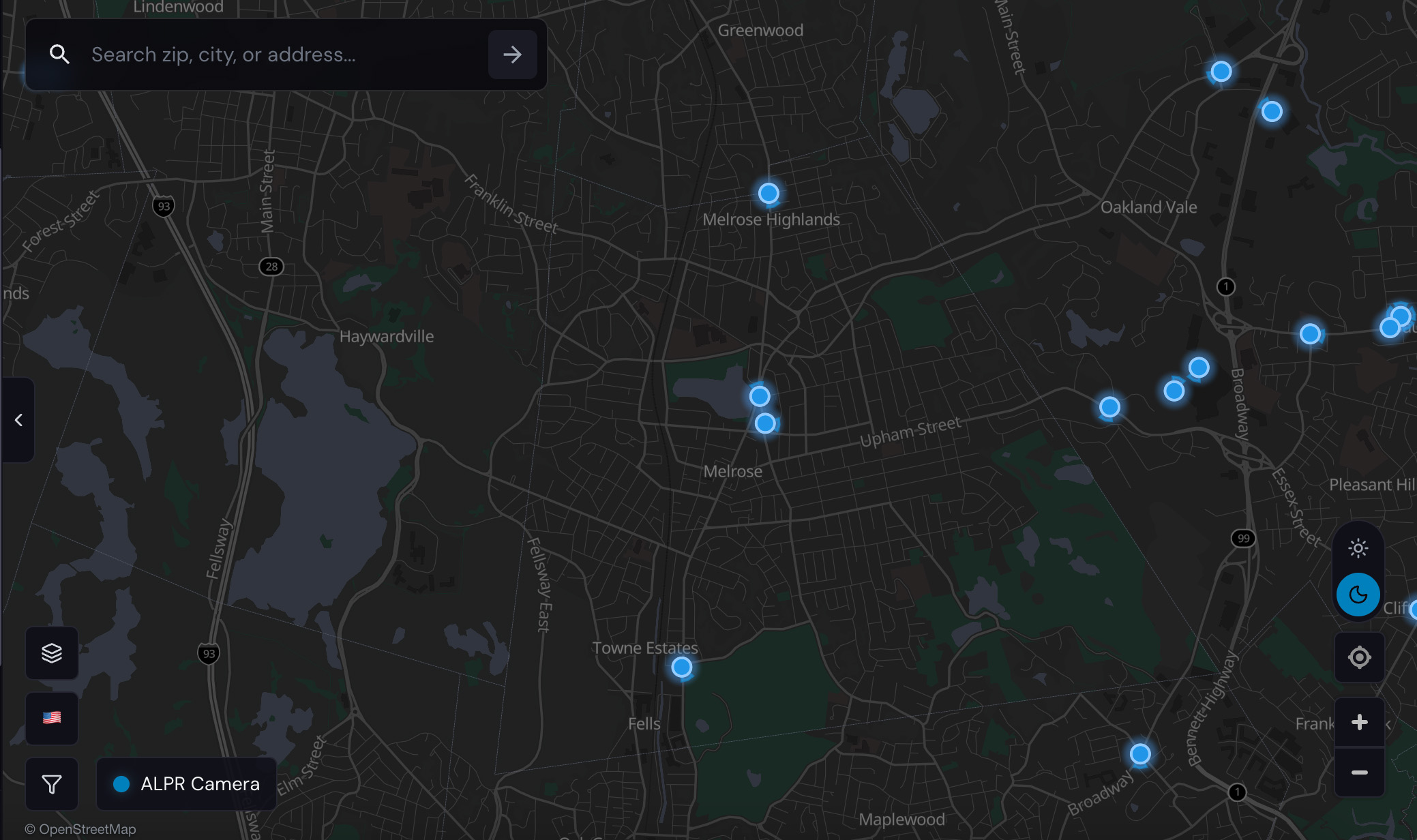
Flock cameras in Melrose
During questioning, city councilors expressed a range of opinions on Flock and ALPR technology, with some expressing cautious support while others called for cancelling the contract immediately.
“The mistrust is not with your department,” City Councilor John Obremski told Chief Faller. “The mistrust is with the company itself and what they do with the information and who can really access it.”
“I’m not married to Flock,” Chief Faller responded. “The larger picture is the ALPR: whether or not the community wants the actual technology. If we continue with the technology, I’m always open to exploring other companies. We’re not locked in.”
Chief Faller expressed that, while he believes that ALPR technology is a boon for his department in terms of helping his officers be more effective at their jobs as they keep the community safe, he is also dedicated to listening to the community and hearing their feedback.
Recently, he noted, MPD decided to shorten the time that files from their three Flock cameras are kept from 30 days to 14 days after hearing feedback from city councilors and community members. They also reduced the list of agencies data is shared with to 89 agencies, all located within Massachusetts.
“Flock is a startup,” noted Councilor Williams. “They were founded by four guys from Georgia. So you’re talking about a nationwide network of hundreds of thousands of cameras, and the accountability for this is four guys in a startup. That concerns me.”
City Councilor Maya Jamaleddine expressed concern that, although Flock states that its data may not be used for immigration purposes, it may still be used by agencies outside the Melrose Police Department to target marginalized people, including undocumented immigrants.
“Yes, we may be securing the safety of all of us,” said Jamaleddine, “but at what cost? Is it at the cost of minorities? How much trust can we put, not in you or your department, but in these tools? I am asking you to remove these cameras immediately,” she went on, “because every second we still have them, we are risking the safety, not of those who have privilege, but those who are living in fear from the government.”
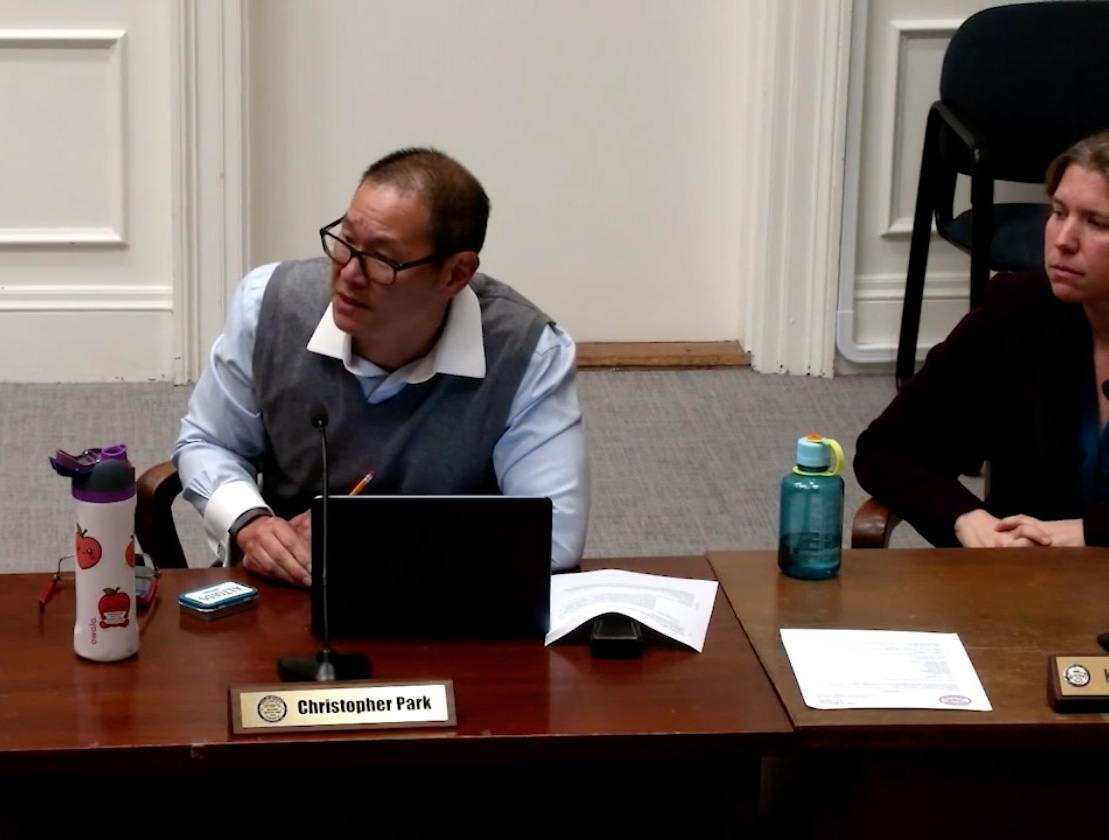
City Councilor Christopher Park
City Councilor Christopher Park drew on his background in software engineering to question how trustworthy Flock Safety might be. “I do know that the terms and conditions of licenses can very conveniently change at the company’s discretion,” he said. “The very fact that our licenses have cost $13,000 for five years is rather telling. That’s a bargain. And to me, it’s indicative of the fact that the data they are collecting is worth more than whatever subscription fee we are paying. And it’s also not a coincidence that it’s lower than the amount that would need to get City Council approval. These are the games that they’re playing.”
“We’re in this lag where the technology has outpaced the laws, and we’re all waiting for the laws to catch up,” added City Councilor Jason Chen. “But in the meantime, we’re seeing abuses happening at different levels. This needs to be regulated at the state or national level, but that just hasn’t happened yet. And until it does, we’re all trying to deal with it in our own way.”
Over a dozen residents shared their opinions on Flock cameras during public comment or in statements, and more residents attended the hearing. Many of the commenters urged the City Council to either end Melrose’s contract with Flock Safety or ensure that more safeguards are in place to prevent abuse.
While commenters expressed concerns about the technology, most drew a distinction between Flock Safety and the Melrose Police Department, and many commenters expressed their support of and trust in Chief Faller and the MPD.
“There are a range of problems with these cameras,” said one commenter. “There are the one-off problems, like the misuse and abuse that we’ve seen police officers exercise across Massachusetts. And then there are the macro problems - the effects that dragnet security has on our community as a whole. The chilling effect surveillance has on lawful behaviors, such as attending political events and accessing medical care.”
“Any steps we take as a municipality are dealing with the wrong layer of the problem,” the commenter went on. “We cannot control the behaviors of Flock and other surveillance companies. We’re being asked to trust a private surveillance company with information about our day-to-day lives. We could talk until we’re blue in the face about strict access controls, audits, retention limits, disabled sharing, but debating these details misses the central problem. We cannot control the company.”
“We’ve been lied to by these technology companies,” said another commenter.
“This is about civil rights,” said a third commenter. “We have no control as a community over this technology that is being implemented within our town. We have no assurances. We have no data protection. We cannot opt out of this as individuals. I can leave my phone at home so nobody knows where I am. I cannot opt out of this.”
“I would like this contract with Flock canceled,” said a fourth commenter, “and to not allow our small town to be taken over by even more tech companies. I just don’t know where we draw the line into becoming a surveillance state.”
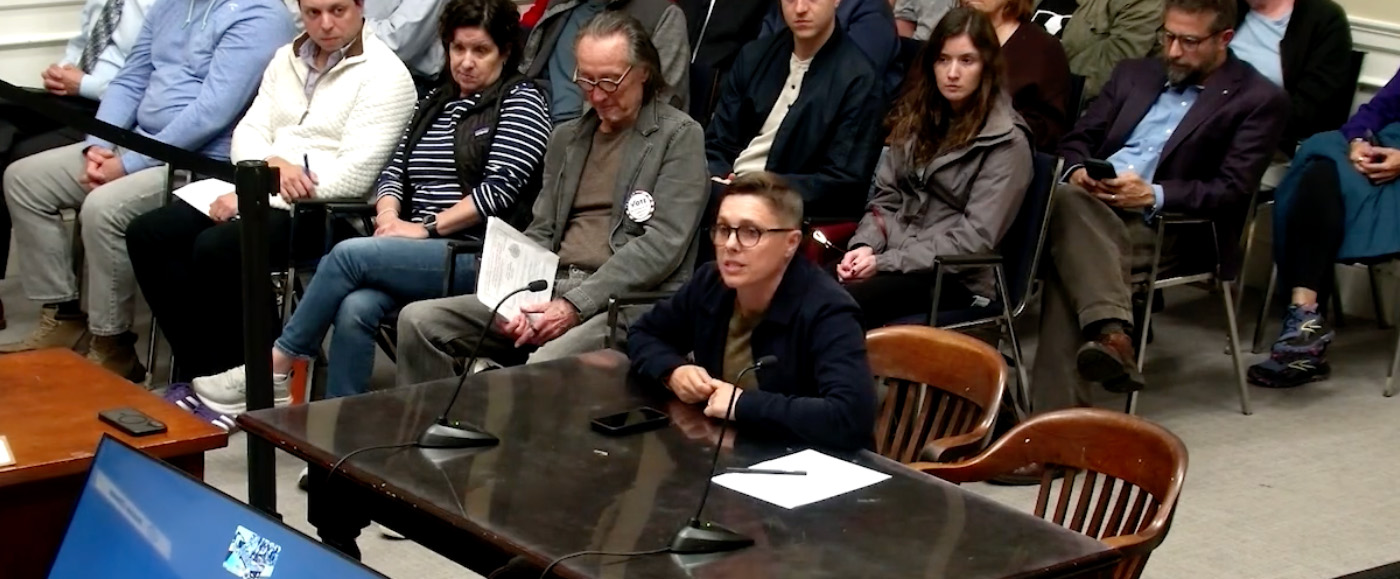
Kade Crockford of ACLU of Massachusetts
Kade Crockford of the ACLU of Massachusetts also spoke during public comment. “One of the reasons that people have such an issue with this technology,” they said, “is that it is designed to track all of us, not just people who are suspected of a crime. It tracks every single car on the road.”
Crockford noted that there have been documented instances where data from Flock cameras has been shared outside of the limits set by clients. They also noted that Flock’s own stated accuracy rate of 93% suggests that 7% of the millions of images that its systems collect every day are misidentified. “I think that’s an unacceptable number,” Crockford said.
“The argument is that, in some cases, this technology enables police to find dangerous people faster than they would otherwise be able to,” Crockford said in a separate conversation. “But we have to weigh those claims against the reality that this technology endangers immigrants and the ex-partners who are victimized by its misuse. It contributes to the feeling that, even in a democracy where we ostensibly have Fourth Amendment protections, you are being watched everywhere you go, even if you haven’t done anything wrong.”
“No one disagrees that, if the Fourth Amendment didn’t exist, it would be easier for police to solve crimes,” Crockford went on. “But it would also expose all of us to serious threats to our personal safety. The Fourth Amendment exists because we need guardrails to limit the government’s power to intrude on our lives.”

City Councilor Maya Jamaleddine
Chief Faller expressed his hope that the state will pass legislation that includes guidelines for the use of ALPR technology, which would create consistency across different departments and agencies.
Crockford agreed that legislation at the state level governing ALPR technology is needed, and noted that Massachusetts and Rhode Island are now the only two New England states that do not address ALPRs in state law. “We’re really behind,” they said, “and this is not new. We’ve been urging state lawmakers to pass comprehensive rules imposing checks and balances on police use of technology for over ten years. Now is the time.”
Crockford noted that if a technology company that has a contract with a state or local government violates the law, they can be sued by the state’s Attorney General. But because there are currently few state laws in place governing the appropriate use of technology and personal data, the Attorney General can do little to address actions that are not strictly illegal. “What we’ve seen is companies don’t have to lie,” Crockford said. “They just have to have extremely long terms of service that no one will read. And this is why data privacy legislation is so important.”
Over the last few months, dozens of municipalities in Massachusetts have chosen to cancel contracts with Flock, or put use of ALPR technology on hold altogether. Crockford said, “I think it’s appropriate for a community to say that, until we have state law imposing guardrails on the government’s use of this technology, we shouldn’t be using it.”
But Chief Faller expressed concern about putting ALPR use on hold until legislation is passed at the state level. “The legislature just never moves fast,” he said. He noted that Cambridge recently suspended their use of ShotSpotter technology, and soon afterward, a city employee was shot and killed. “If ShotSpotter wasn’t suspended, could that gentleman have survived instead of bleeding out?” Faller asked. “That’s a very traumatic, very extreme example, but that’s why I’m standing firm. I’m not suspending [ALPR use] because I don’t want that on my shoulders.”
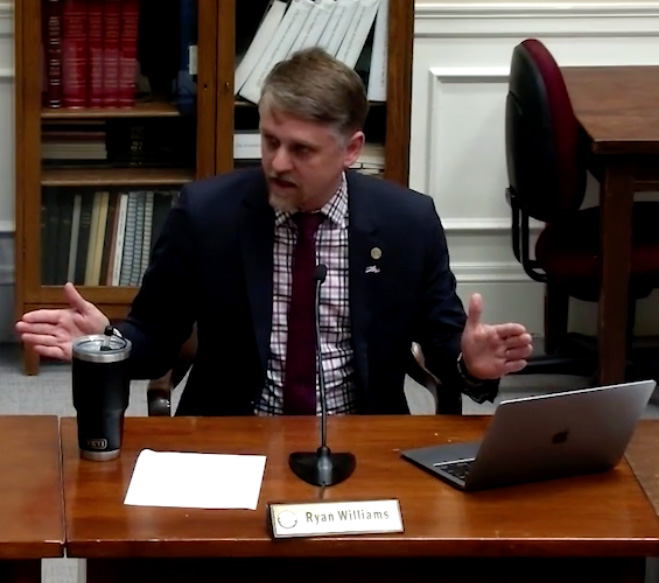
City Councilor Ryan Williams
Mayor Jen Grigoraitis wrote in a memo shared with the City Council: “I recognize that there are many questions and concerns regarding ALPR technology in general and Flock Safety specifically, and I appreciate the conversations I have had with several councilors on these topics. While there are potential public safety uses of ALPR technology, we must balance that with concerns about civil liberties and privacy raised by these devices. In my conversations with Chief Faller, I have stated my preference for the department to put the use of this technology on hold to take in feedback from the Council and the public.”
“Going forward,” the memo went on, “the city solicitor will work with the police chief on contract terms and conditions with any and all ALPR vendors to ensure that appropriate legal safeguards, especially around information sharing, are put in place, and any feedback received from Council can be considered for incorporation into the terms of a formal agreement. Furthermore, should the Council wish to enact any guardrails around the use or procurement of ALPR technology, my administration stands ready to collaborate on developing language for the City code to ensure that MPD can continue to effectively maintain public safety while also providing greater transparency.”
“It just reminds me that all of us in this room are for sale,” reflected Councilor Williams. “All of our data drives a huge portion of the American economy, and we lost so many of these fights before we knew that we were in them. Our social media data, our cell phone data. So I do think it’s really a question of: Does the public feel that ALPR surveillance is worth it?”
If the City Council decides to take further action on this matter, they could potentially draft legislation limiting or banning the use of ALPR technology in Melrose, or requiring City Council approval for any new surveillance technology.