Melrose Teachers Describe Effects of This Year’s Budget Cuts
By Ellen Putnam
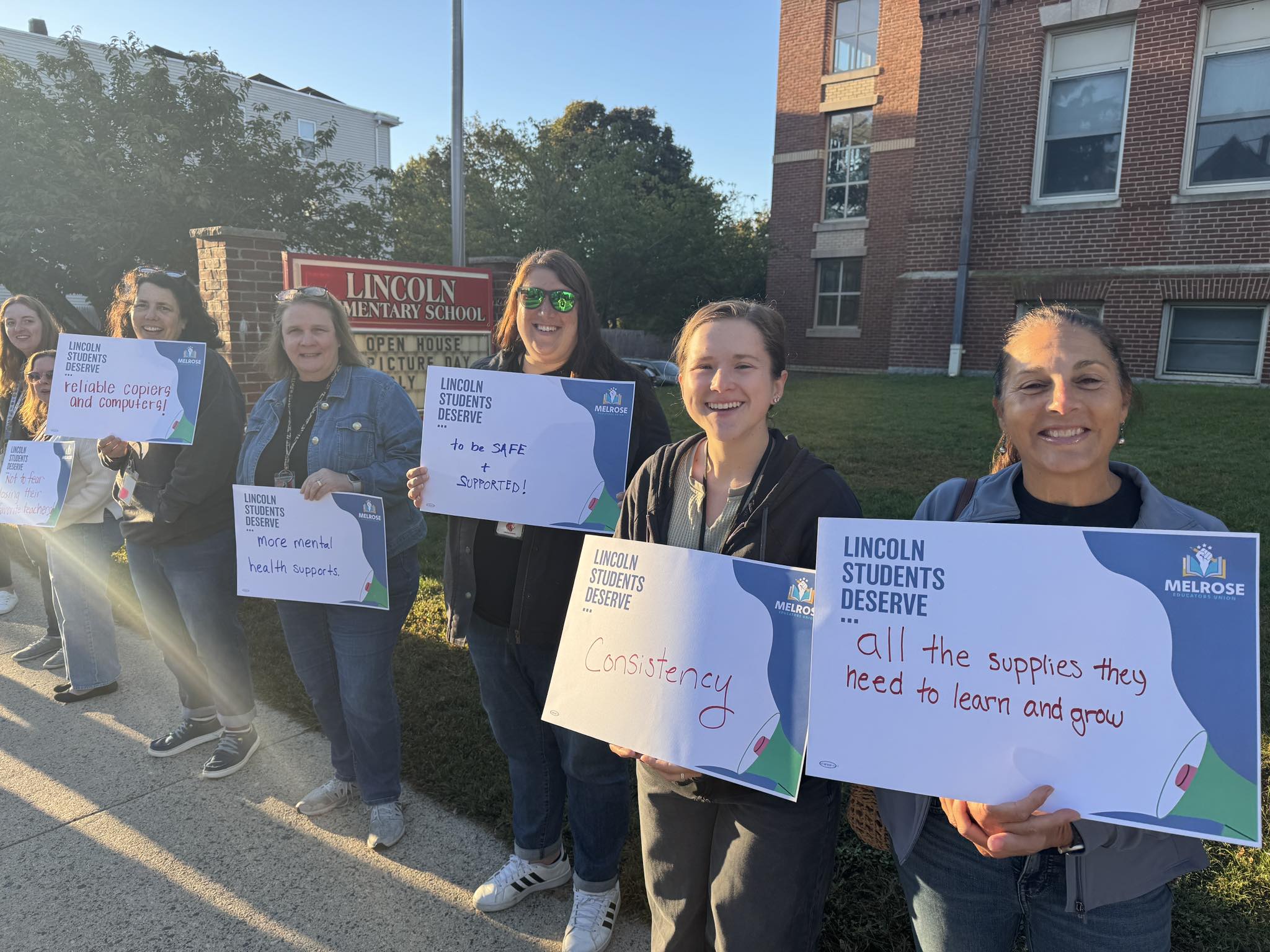
Teachers at the Lincoln School
Photo From Melrose Educators Union
As Melrose residents vote on three override questions, we spoke with several Melrose teachers about their experiences with current resource and staffing levels so far this school year.
This school year is the second in a row that the Melrose Public Schools have seen service cuts: last year, the school budget saw $4.2 million in cuts relative to the superintendent’s proposed needs-based budget; then, this year, the schools saw an additional $3.7 million in cuts. (The total school budget this year was $47 million.) This is due to rising costs in a number of areas, including contractual salary increases, special education and transportation costs, and health insurance increases, that are growing faster than the 2.5% the city is allowed to raise taxes by under Proposition 2½.
An override vote in June 2024 that would have avoided last year’s cuts failed; now, Melrose is voting on three potential override levels: $13.5 million, which would reverse many of the cuts that were made over the last two years; $11.9 million, which would reverse some of the cuts; or $9.3 million, which would stabilize the budget at current levels and avoid having to make an additional $4 million in cuts next year (the amount that is currently projected across the city and school budgets if no override passes).
This year’s cuts reduced the district’s central administration to barebones levels, eliminated the middle school principal position, and cut teacher positions at every school, increasing class sizes that had typically hovered around 20 students to over 25, and in some cases, to over 30. This increase in class sizes has caused strain on both teachers and students in a number of ways.
At the elementary level, larger class sizes strain even the physical environment. One elementary teacher described how the largest classes can no longer have a classroom rug for morning meetings and storytimes - there simply isn’t enough space in the classroom. Teachers have had to develop hand signs for children to use when they need to get up for a tissue or to sharpen a pencil, because there isn’t enough space in the classroom for them to move around freely.
“It’s the physicality of making those little bodies stay seated,” she said, “and it’s impacting the comfort and desire and enjoyment of being an elementary student - we’re having a hard time just meeting their basic needs, never mind trying to get everyone proficient on every math standard.”
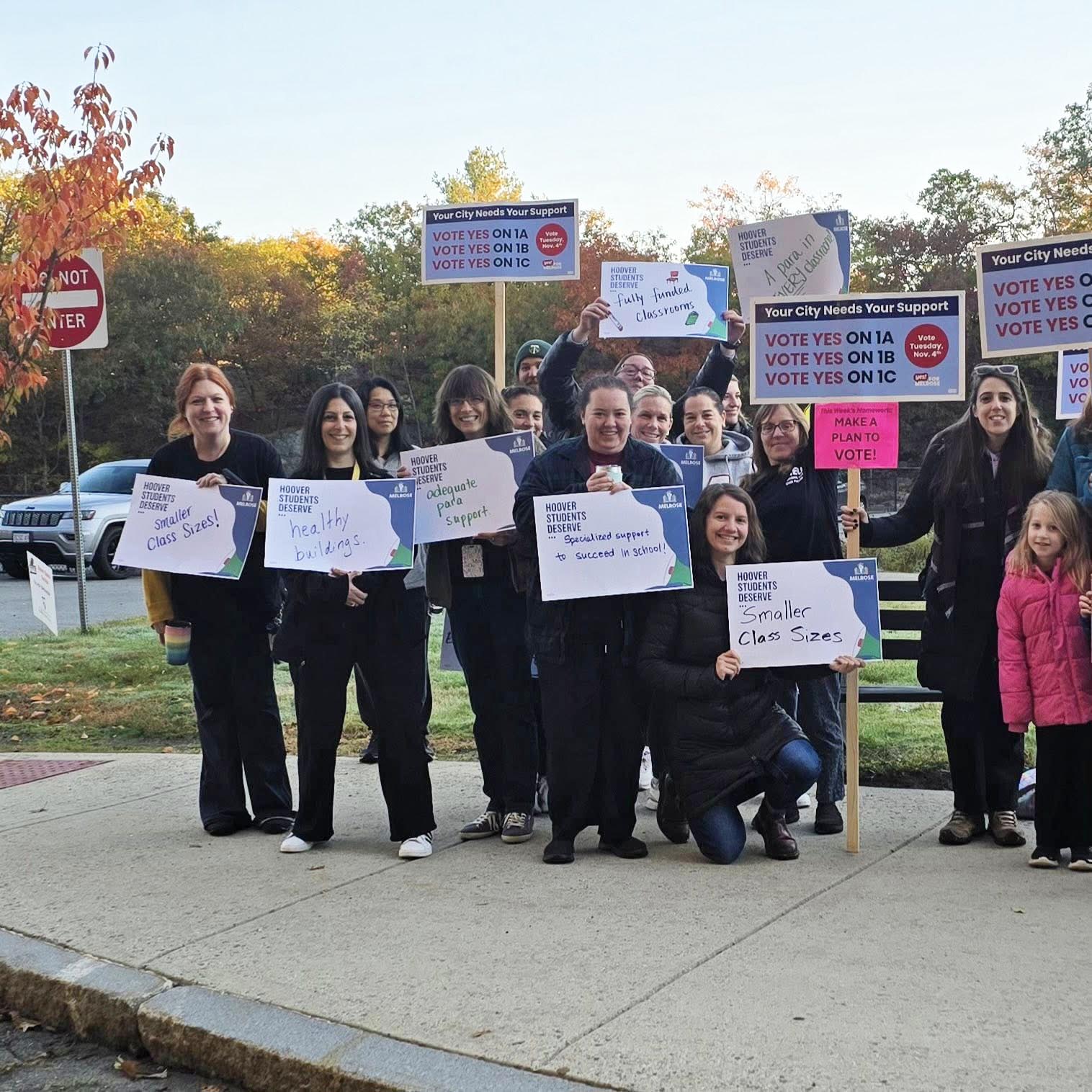
Teachers at the Hoover School
Photo From Melrose Educators Union
“A lot of what we do at the elementary level is personalized learning and small group instruction,” she went on. “But with that many kids, a small group is no longer small - it’s eight or nine kids. And that’s not the individual attention that a lot of kids require in order to learn. It doesn’t provide the same level of intervention, and it doesn’t make it easy to build relationships and community. We want the classroom to be a safe place for our kids, but when you don't have as much time to devote to each child, it’s that much harder.”
And a lack of appropriate intervention, especially in the youngest grades, can have a major impact later on. While many of the students who receive special education services, including those who attend specialized schools out-of-district, would need those services regardless, consistent intervention in the classroom early on could very likely prevent some of those students from needing more support in the future - benefitting both the child and the district’s bottom line.
Even for teachers who aren’t seeing the largest class sizes at the elementary level, adding just a few more kids to a class can make a big difference in how they’re able to teach. “Maybe it’s a change since COVID,” reflected one teacher, “or maybe it’s just the way things are right now, but kids have much more complex needs right now, and they require a lot more support. Even if you only have two more kids in your classroom, that increase is noticeable.”
Class sizes increased more dramatically at the middle and high schools, where more teacher positions were eliminated this year.
One high school science teacher described trying to do a lab involving Bunsen burners with open flames in a class with 30 students in it. “We have flames in excess of 500 degrees,” she said, “and I’m just trying to keep everyone safe. My classroom is not huge, and most high schoolers are adult-sized, and we have all of their backpacks, too - we have to make sure none of them is a trip hazard. I’m trying to give these students the experience I’ve given other students over the years, and not leave them out just because we have larger class sizes, but safety is a big concern.”
Another high school teacher described the loss of collaboration time with other teachers. “We’re a tight department,” he said, “and we don’t get any department time, except when we happen to have lunch together. We’re going to see departments just crumble - we’re going to lose the structure of how a department works together because they’ve had to cut all of our time together. As soon as you lose the culture of a school, it’s gone for years and years - and that’s what’s being destroyed now.”
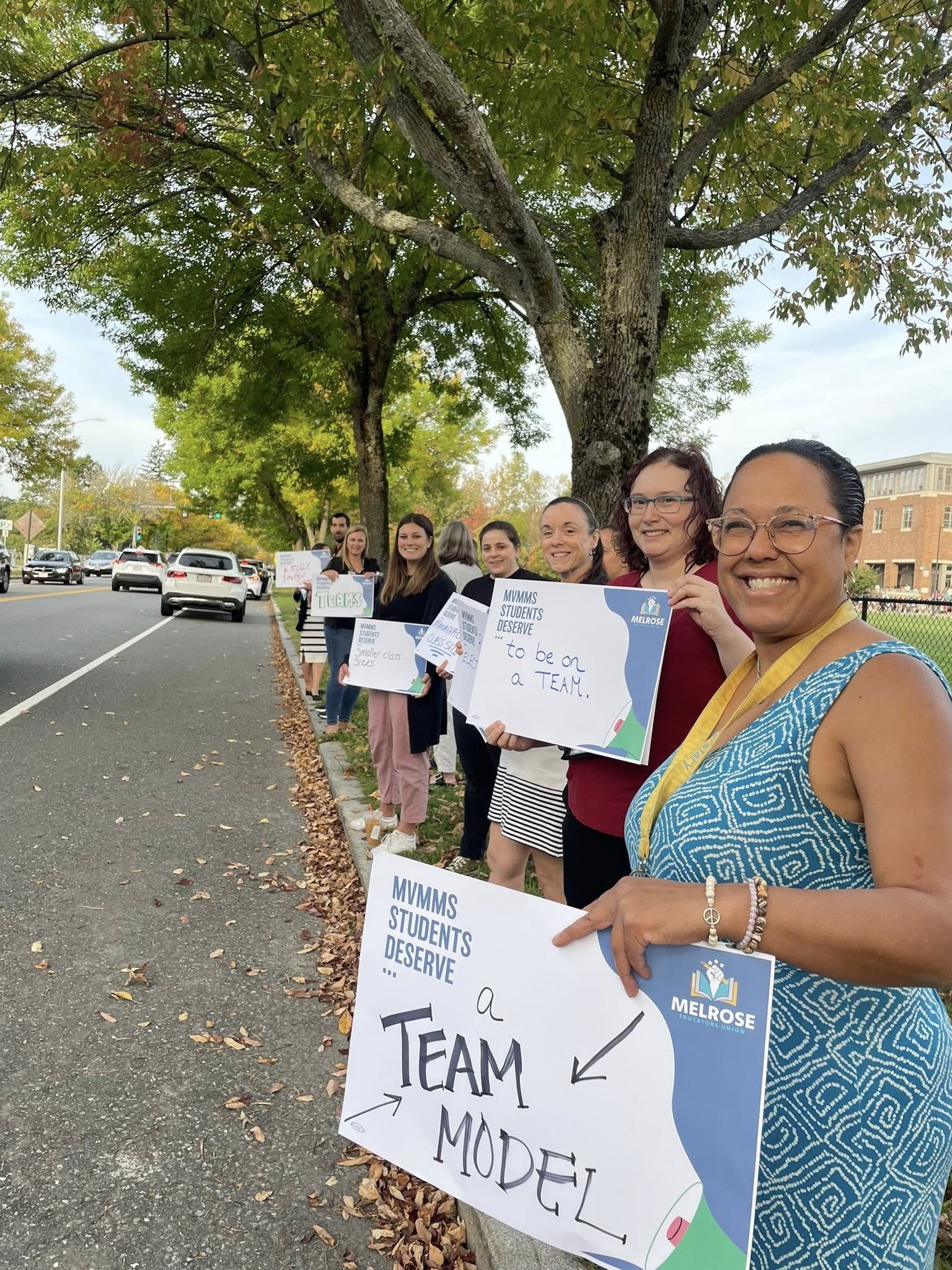
Teachers at Melrose Veterans Memorial Middle School
Photo From Melrose Educators Union
At the middle school level, teachers have been adapting to the loss of the team model. Some of their concerns are logistical - how to plan a field trip or run parent-teacher conferences - while others go deeper. “The team model is unique to the middle school,” said one teacher, “and the middle school age group is really unique. There’s a tremendous need to have that wraparound support of the team model - especially in 6th grade, when kids are moving from a single classroom teacher to having four core teachers, lockers, a schedule that changes day-to-day - there’s so much complexity to managing that, and not having teachers be able to communicate with a set group of students is real loss for that age group.”
Teachers at both the middle and high schools expressed general satisfaction with having Jason Merrill take over leadership of the middle school as the Secondary Principal. “He’s been doing this job for a really long time,” said one teacher, “and he’s put in place a lot of really good systems and procedures at high school that they’ve been able to really quickly roll out at the middle school.”
“My biggest concern,” she went on, “is whether or not this is sustainable. We’re only in October, and we’re doing OK right now, but situations compound and things get more complicated as the year goes on. When we get to MCAS testing season and the administrators are overburdened, will we have the level of support that we need? I’m nervous about whether or not this can go on for the long haul.”
Cuts to the city side of the budget are also being felt in the schools: multiple teachers in different buildings observed that the classrooms and hallways at their schools are less clean than they have been in past years, due to budget cuts in the Department of Public Works, which oversees the school custodians.
“It really has an impact on student behavior and the way they approach their day,” one middle school teacher said, “when they walk into a building that hasn’t been swept or cleaned and there’s trash lying around. It’s not anyone’s fault, the custodians we have are doing the best job that they can - there’s only so much that they’re capable of doing in a building that services 900 teenagers.”
It all adds up to what, for many teachers, sounds dangerously close to burnout.
One high school teacher, who entered teaching as a second career, reflected, “I’ve worked high-pressure jobs in industry, and not a whole lot phases me - but teaching is the hardest thing I’ve ever done. It’s all go, all the time. If we’re lucky, we have one prep a day - but we’re so exhausted, we spend the first twenty minutes asking, ‘What just happened? Where’s the bus that just hit me?’ We’re overwhelmed.”
“Everybody here is doing the jobs of so many other people,” an elementary school teacher described. “We’re all at the end of our rope at the end of the day, and even the best and brightest of us are absolutely drained. It’s getting harder and harder to come back in the next day, fresh and ready to go. Everybody is so overworked and stretched thin - it’s absolute exhaustion.”
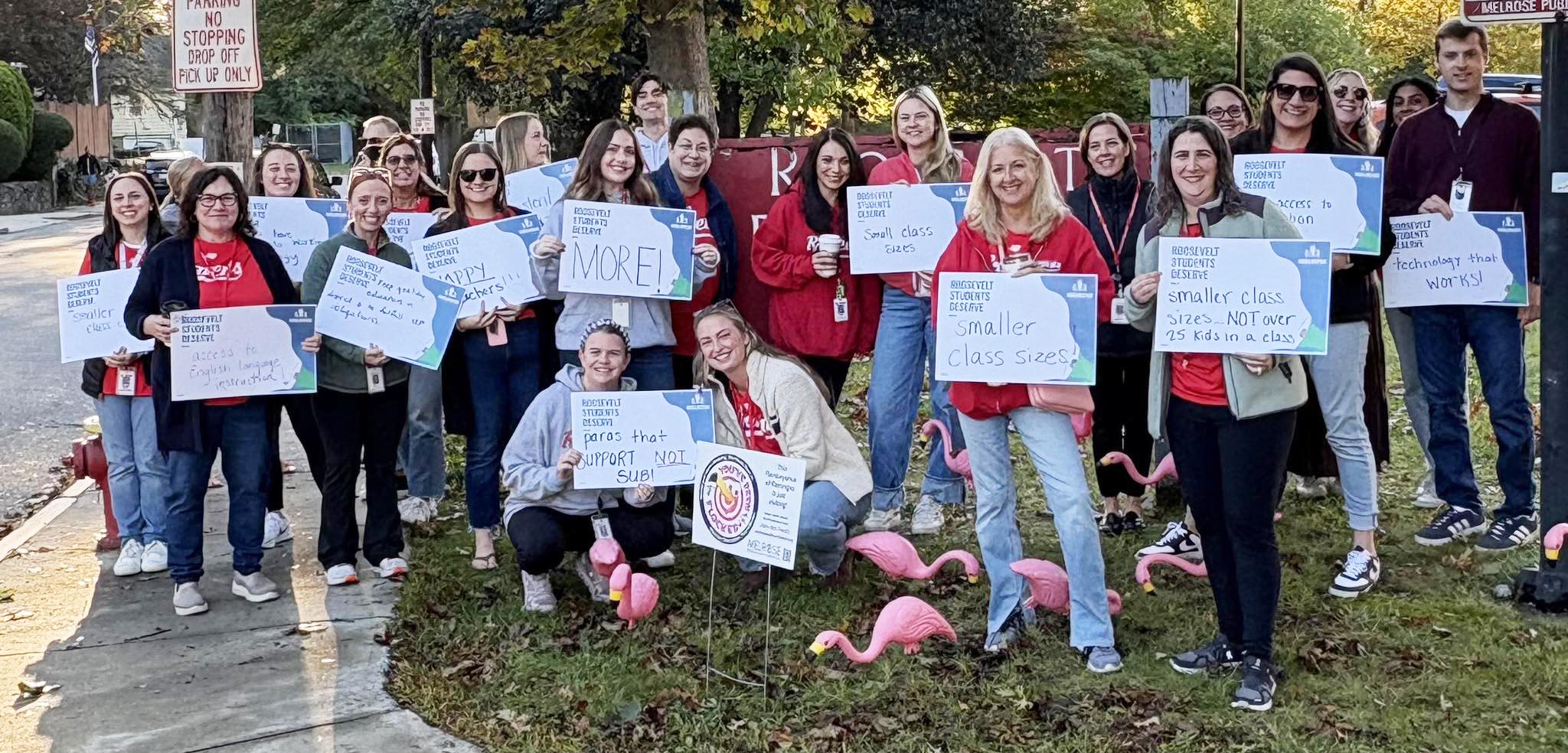
Teachers at the Roosevelt School
Photo From Melrose Educators Union
One element that makes things that much more challenging is that there are still unfilled positions in the district - especially for paraprofessionals, who are often not well compensated relative to other roles. This means that the duties of those unfilled roles fall on other staff members. (While it might seem surprising to have vacant positions in a year after dozens of staff were laid off, other staff have left voluntarily since this spring’s layoffs - some for districts with more stable finances. Other positions are legally mandated, but the district struggles to find candidates for them.)
“We cannot find people to do these jobs,” one teacher reflected, in part because Melrose pays less than other districts, and in part because, she said, “it’s so wrought with uncertainty.”
Another teacher added, “I’ve heard a couple of anecdotes - someone has a friend who lives in town and would love to work in Melrose, but they didn’t apply for the positions that opened up when people left - they’re not going to leave their stable position somewhere else to work here.”
While restoring all of the positions that were lost over the last two years would not happen with any of the three override amounts, the teachers we spoke with didn’t see that as necessary in order for the situation to improve. “At the high school,” one teacher said, “just getting back the teacher positions we lost this year would alleviate so much. Everyone would have less work to do, fewer papers to grade, fewer students to keep track of.”
She went on, “administrators have talked about: we’ll see how this year goes, and maybe we can rethink this model. Maybe we don’t need all of the people we had - we just need to think about how we’re putting people in classrooms, how we’re structuring support for teachers. I think we could create a model that provides that support without adding more administrators - it’s just a matter of thinking about people’s time, and there’s not enough of it if we don’t have enough teachers to cover the classes we have.”
According to the city, the highest override option, $13.5 million, would restore 17 school positions - an average of slightly more than two positions per school. The middle option, $11.9 million, would restore nine school positions, and the lowest option, $9.3 million, would restore three.
While residents won’t know until next year exactly what would be cut from the school budget if no override passes, it’s difficult to envision the city being able to make the projected $4 million in cuts without closing one of the district’s five elementary schools - an option that was discussed, but avoided, during last year’s budget process. And while Melrose has closed schools during budget crises in the past, including the Beebe and Ripley Schools, the district would likely be hard-pressed to find space for the 250 students who attend the Horace Mann or the Hoover - the district’s two smallest schools - across the remaining four elementary schools.
Voting in this year’s municipal election, including on the three override questions, continues at City Hall on Thursday, October 30th (8:30am to 4pm) and Friday, October 31st (8:30am to 12:30pm), and at the Melrose Veterans Memorial Middle School on Tuesday, November 4th (7am to 8pm). You can find the rest of our override coverage here, and our coverage of all of the candidates for office here.